Free IPv6 Compression & Expansion Tool
Compress full IPv6 addresses to their shortest form or expand abbreviated IPv6 to the complete 128-bit notation. Our free IPv6 compression calculator follows RFC 5952 standards for canonical representation.
Free IPv6 ToolIPv6 CompressionRFC 5952Compress & Expand
IPv6 Compress / Expand
Advertisement
What Is IPv6 Address Compression?
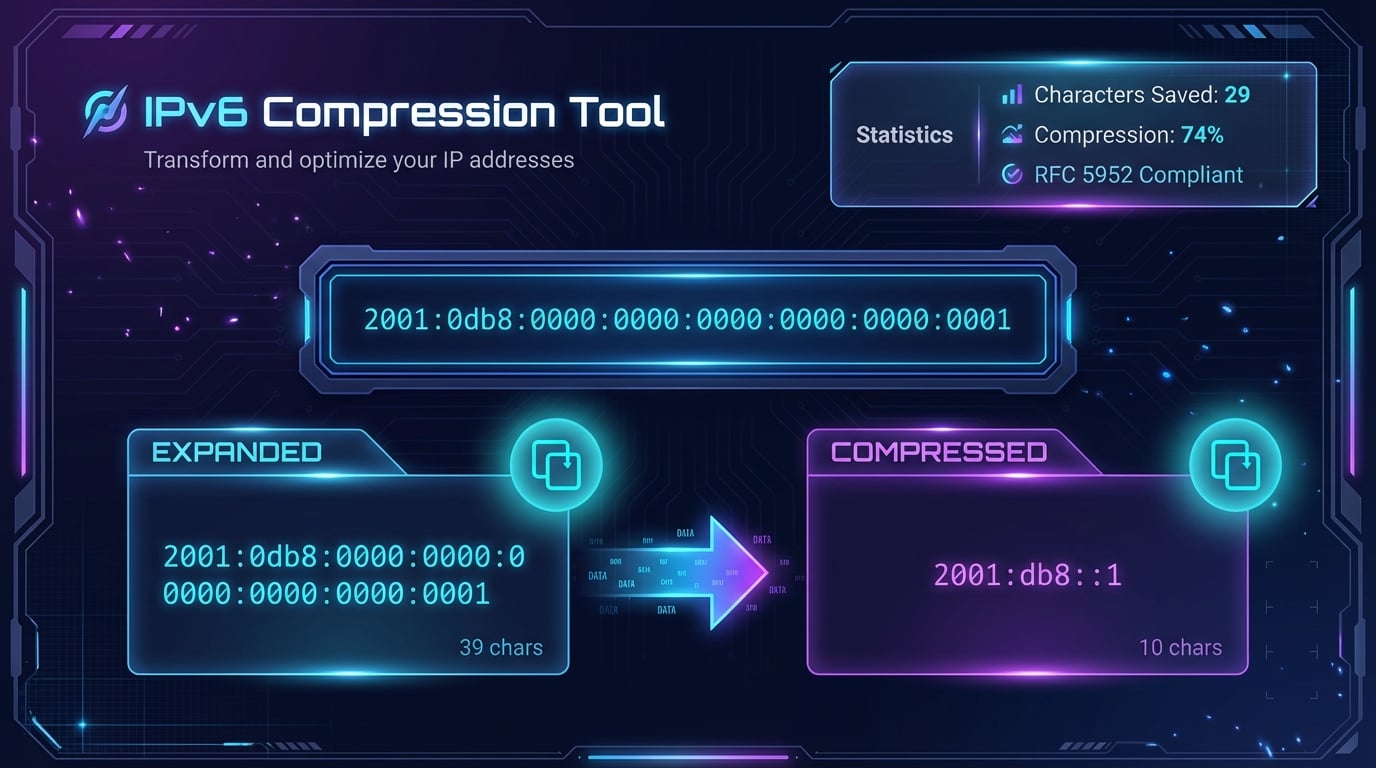
IPv6 address compression is the process of shortening a full 128-bit IPv6 address into a more readable, compact form. A full IPv6 address consists of eight groups of four hexadecimal digits separated by colons — for example, 2001:0db8:0000:0000:0000:0000:0000:0001. That's 39 characters, which is impractical for configuration files, firewall rules, and documentation.
RFC 5952 ("A Recommendation for IPv6 Address Text Representation") defines the canonical rules for IPv6 compression. By applying two simple rules — removing leading zeros and replacing the longest consecutive zero-group run with :: — the address above compresses to just 2001:db8::1 (10 characters). Our free IPv6 compressor applies these rules instantly to any IPv6 address you enter.
How to Compress an IPv6 Address
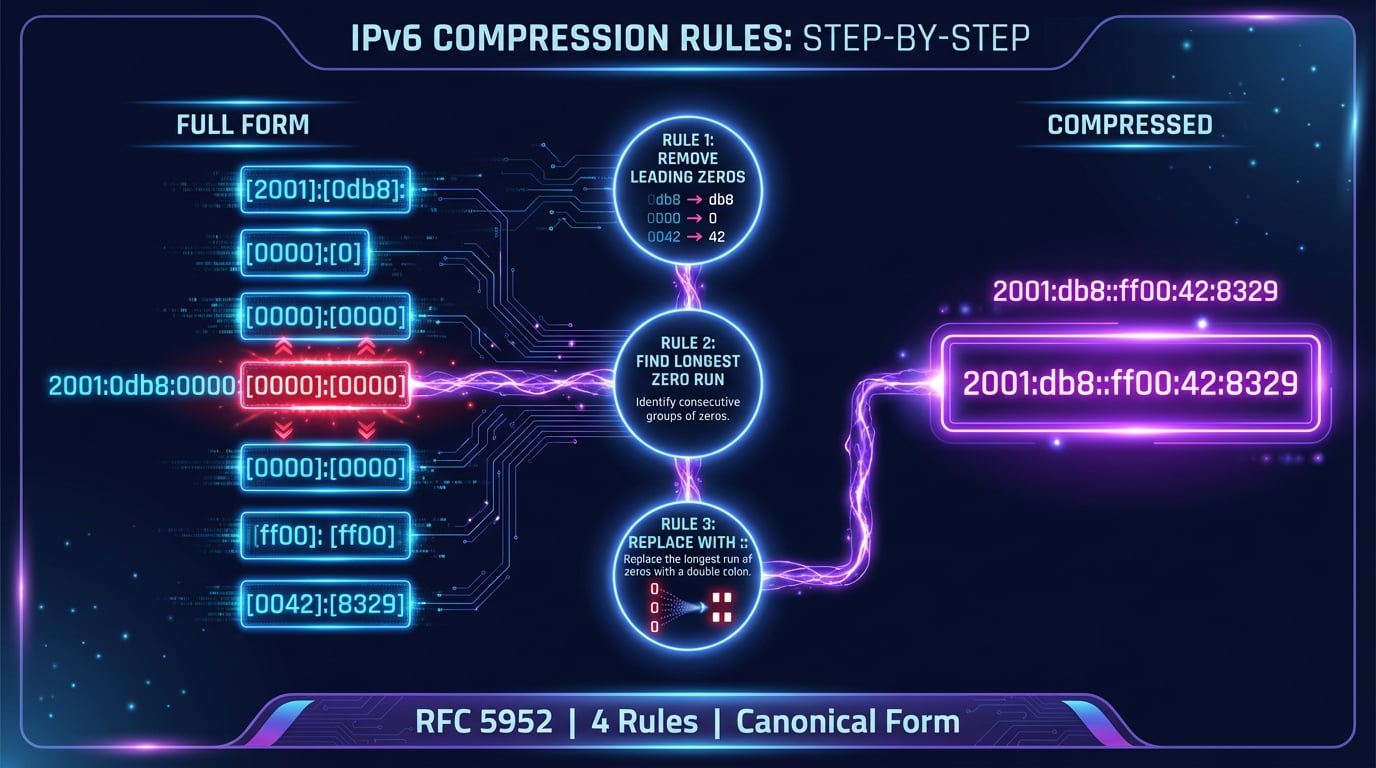
Compressing an IPv6 address follows three straightforward steps. Here's how to compress IPv6 address 2001:0db8:0000:0000:0000:ff00:0042:8329 as an example:
1
Remove leading zeros in each group
0db8 → db8, 0000 → 0, ff00 → ff00, 0042 → 42
Result: 2001:db8:0:0:0:ff00:42:8329
2
Find the longest run of consecutive zero groups
In 2001:db8:0:0:0:ff00:42:8329, groups 3-5 are all zeros (3 consecutive groups). Replace them with ::
3
Apply the double colon (::)
Final compressed IPv6 address: 2001:db8::ff00:42:8329
The :: can only appear once per address to avoid ambiguity.
Advertisement
IPv6 Compression Rules (RFC 5952)
RFC 5952 defines four rules for the canonical text representation of IPv6 addresses. Understanding these rules is essential for anyone working with IPv6 address compression:
1Remove Leading Zeros
Leading zeros in each 16-bit group must be suppressed. 0db8 → db8, 0000 → 0
2Replace Longest Zero Run with ::
The longest consecutive sequence of all-zero groups is replaced with :: (double colon).
3:: Appears Only Once
The :: can only appear once per address. If two zero runs are equal length, the first one is compressed.
4Use Lowercase Hex Digits
Hexadecimal digits a through f should be represented in lowercase for consistency.
| Rule | Before | After |
|---|---|---|
| Remove leading zeros | 2001:0db8:00ff:0000 | 2001:db8:ff:0 |
| Zero run → :: | 2001:db8:0:0:0:0:0:1 | 2001:db8::1 |
| First of equal runs | 2001:0:0:1:0:0:0:1 | 2001:0:0:1::1 |
| Lowercase hex | FE80:0000:0000:0000 | fe80:: |
How to Expand a Compressed IPv6 Address
Expanding a compressed IPv6 address reverses the compression process to restore the full 32-hexadecimal-digit, 8-group form. This is useful when entering addresses into configuration tools that require the full format, or when comparing addresses programmatically.
Expansion Steps
- Count the existing groups (non-:: parts)
- Replace
::with enough0000groups to reach 8 total - Pad each group to 4 hex digits with leading zeros
Example
Compressed: 2001:db8::ff00:42:8329
Groups present: 5 → need 3 zero groups
Expanded: 2001:0db8:0000:0000:0000:ff00:0042:8329
Advertisement
IPv6 Compression Examples
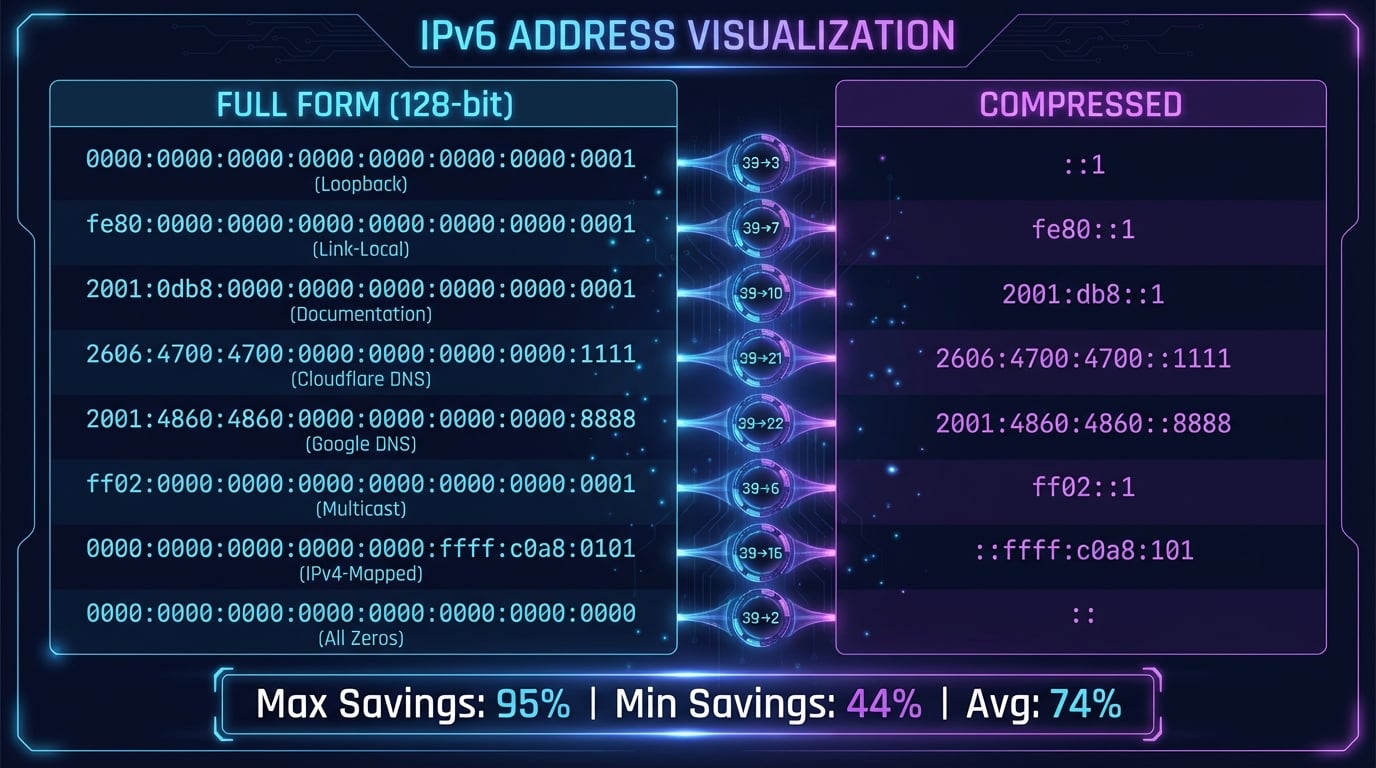
Here are common IPv6 addresses shown in both full (expanded) and compressed forms. These examples demonstrate how IPv6 address compression dramatically shortens addresses used in everyday networking:
| Address | Full (Expanded) | Compressed |
|---|---|---|
| Loopback | 0000:0000:0000:0000:0000:0000:0000:0001 | ::1 |
| All Zeros | 0000:0000:0000:0000:0000:0000:0000:0000 | :: |
| Link-Local | fe80:0000:0000:0000:0000:0000:0000:0001 | fe80::1 |
| Documentation | 2001:0db8:0000:0000:0000:0000:0000:0001 | 2001:db8::1 |
| Cloudflare DNS | 2606:4700:4700:0000:0000:0000:0000:1111 | 2606:4700:4700::1111 |
| Google DNS | 2001:4860:4860:0000:0000:0000:0000:8888 | 2001:4860:4860::8888 |
| IPv4-Mapped | 0000:0000:0000:0000:0000:ffff:c0a8:0101 | ::ffff:c0a8:101 |
| Multicast (All Nodes) | ff02:0000:0000:0000:0000:0000:0000:0001 | ff02::1 |
When You Need IPv6 Compression
IPv6 compression isn't just an academic exercise — it's essential for everyday network administration. Here are six common situations where you need an IPv6 compressor or expander:
Firewall Rules
ACLs and firewall rules use compressed IPv6 for readability. A 39-character full address in every rule makes configs unmanageable.
Server Configuration
Web servers (Apache, Nginx), database configs, and application settings typically use compressed IPv6 notation.
DNS Zone Files
AAAA records in DNS zones use compressed IPv6. Our DNS Lookup tool shows these records for any domain.
Network Documentation
Network diagrams, IP address plans, and runbooks are far more readable with compressed IPv6 addresses.
Log Analysis
Searching logs for IPv6 addresses requires knowing both forms. A compressed address won't match a full-form search.
Programming
APIs and applications often need to normalize IPv6 addresses to a consistent format for comparison and storage.
Advertisement
Related Tools
IPv4 to IPv6 ConverterConvert between IPv4 and IPv6 address formats
Subnet CalculatorCalculate IPv4 & IPv6 CIDR subnets and ranges
IP LookupLook up geolocation, ISP, and ASN for any IP
IP to Decimal ConverterConvert IPs between decimal, hex, and binary
Domain to IPFind IPv4/IPv6 addresses of any domain
What Is My IPFind your public IPv4 & IPv6 address
DNS LookupCheck all DNS records including AAAA (IPv6)
Reverse DNS LookupLook up PTR records for any IP address
Frequently Asked Questions
What is IPv6 compression?
IPv6 compression (also called IPv6 address compression) is the process of shortening a full 128-bit IPv6 address to its most compact form by applying two rules defined in RFC 5952: (1) removing leading zeros from each 16-bit group (e.g., 0db8 becomes db8), and (2) replacing the longest consecutive run of all-zero groups with a double colon (::). For example, 2001:0db8:0000:0000:0000:0000:0000:0001 compresses to 2001:db8::1.
How do I compress an IPv6 address?
To compress an IPv6 address, follow three steps: (1) Remove leading zeros in each group — 0db8 becomes db8, 00ff becomes ff, 0000 becomes 0. (2) Find the longest consecutive run of all-zero groups and replace them with :: (double colon). (3) The :: can only appear once per address. If two zero runs are equal length, compress the first one. You can use our free IPv6 compression calculator above to do this instantly.
How do I expand a compressed IPv6 address?
To expand a compressed IPv6 address back to full form: (1) Replace :: with the correct number of zero groups to make 8 total groups. (2) Pad each group with leading zeros to make exactly 4 hex digits. For example, 2001:db8::1 expands to 2001:0db8:0000:0000:0000:0000:0000:0001. The :: represents the missing zero groups (6 groups of 0000 in this case).
What is the :: (double colon) in IPv6?
The double colon (::) in IPv6 is a shorthand notation that replaces one or more consecutive groups of all zeros. It can only appear once in an address to avoid ambiguity. For example, in ::1 (the loopback address), the :: replaces seven groups of 0000, expanding to 0000:0000:0000:0000:0000:0000:0000:0001. If an address has two separate zero runs, only the longest is replaced with ::.
What is RFC 5952?
RFC 5952 ('A Recommendation for IPv6 Address Text Representation') is an Internet standard published in 2010 that defines the canonical format for writing IPv6 addresses. It recommends: (1) leading zeros must be suppressed, (2) :: must be used to compress the longest run of consecutive 16-bit 0 fields, (3) if two runs of zeros are equal length the first must be compressed, and (4) hex digits must use lowercase. Our IPv6 compression tool follows all RFC 5952 rules.
Can :: appear more than once in an IPv6 address?
No, the double colon (::) can appear at most once in an IPv6 address. This rule exists because if :: appeared twice, the address would be ambiguous — there would be no way to determine how many zero groups each :: represents. For example, 2001::1::2 is invalid because you cannot tell if it means 2001:0000:0000:0001:0000:0000:0000:0002 or 2001:0000:0001:0000:0000:0002:0000:0000 or other combinations.
What is the compressed form of the IPv6 loopback address?
The IPv6 loopback address in full form is 0000:0000:0000:0000:0000:0000:0000:0001. After compression, it becomes ::1. The :: replaces seven consecutive all-zero groups, and the trailing 0001 becomes 1 after removing leading zeros. This is the IPv6 equivalent of IPv4's 127.0.0.1 and is used to test the local network stack.
What is the difference between IPv6 compression and IPv4 to IPv6 conversion?
IPv6 compression shortens an existing IPv6 address to its most compact form — it does not change the address, only its text representation. IPv4 to IPv6 conversion transforms an IPv4 address (like 192.168.1.1) into an IPv6-mapped format (like ::ffff:192.168.1.1 or ::ffff:c0a8:0101). Use our IPv6 compression tool for shortening IPv6 addresses, and our IPv4 to IPv6 converter for translating between protocols.
Is this IPv6 compression tool free?
Yes, our IPv6 compression tool is 100% free with no registration, no limits, and no ads. All processing happens instantly in your browser — no data is sent to any server. You can compress or expand as many IPv6 addresses as you need. The tool follows RFC 5952 standards for canonical IPv6 representation.
Why do we need to compress IPv6 addresses?
IPv6 addresses in full form are 39 characters long (e.g., 2001:0db8:0000:0000:0000:0000:0000:0001), which makes them difficult to read, type, and manage. Compression reduces them to much shorter forms (e.g., 2001:db8::1 — only 10 characters). This is essential for firewall rules, DNS zone files, server configuration, network documentation, log analysis, and any situation where IPv6 addresses are displayed or entered manually.