How to Start a Medical Transport Business (NEMT) in 2026
Advertisement
What Is a Medical Transport Business?
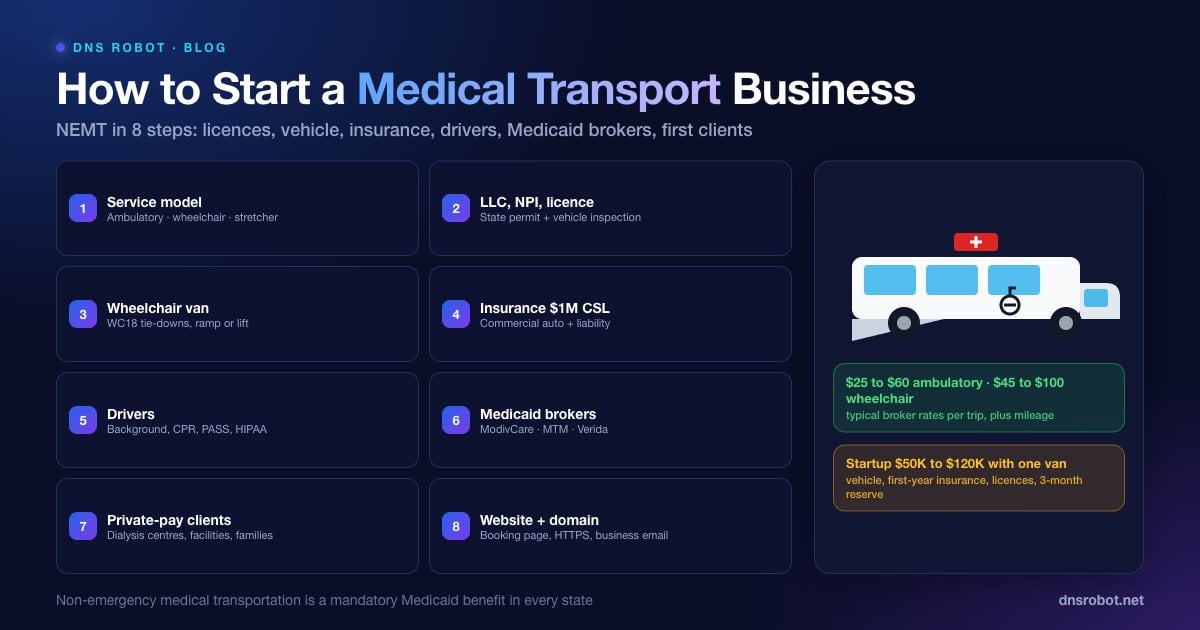
To start a medical transport business you need eight things in order: a service model, a licensed company, a vehicle, insurance, trained drivers, broker contracts, private-pay clients and an online presence. A medical transport business, in the sense most people searching for the term mean, is a non-emergency medical transportation (NEMT) company. It drives patients who cannot use ordinary transport to and from dialysis, chemotherapy, physical therapy, doctor visits, hospital discharges and pharmacy runs. The vehicles are cars, minivans and wheelchair-accessible vans, not ambulances, and the drivers are trained in passenger assistance and first aid, not paramedicine.
Demand is structural. Federal Medicaid rules at 42 CFR 431.53 require every state to assure transportation for beneficiaries to and from covered care, and section 209 of the Consolidated Appropriations Act, 2021 wrote that requirement into the Medicaid statute. States pay for it through transportation brokers, managed care plans or directly, and ride volume grows with the population that needs dialysis and cancer care. The CMS assurance of transportation page, which links the full Medicaid Transportation Coverage Guide, is the document to read first.
This guide walks through the eight steps to start a medical transport business, from idea to first paid trip, what each one costs, and the online setup that wins the private-pay and facility work that keeps a one-van company profitable while it waits on broker volume.
Is a Medical Transport Business Profitable?
It can be, and the economics are simple enough to check on one page. Revenue is trips multiplied by rate. Costs are vehicle, driver, insurance, fuel and admin. Broker and Medicaid rates vary widely by state and contract: as a rough 2026 guide, base rates run from under $20 to about $60 per ambulatory trip and from about $20 to $100 per wheelchair trip, usually plus $1 to $4 per loaded mile. At the low end, North Dakota's Medicaid NEMT fee schedule from July 2025 paid $17.70 per wheelchair van trip plus $2.52 a mile beyond 15 miles. Private-pay rates run higher, often $60 to $150 per trip depending on distance and assistance level.
One wheelchair van doing eight to twelve trips a day on 21 working days, at an average of roughly $48 to $71 per trip including mileage, grosses about $8,000 to $18,000 a month. Reaching that average usually takes a mix of higher-rate broker work and private-pay trips. Against the revenue sits a driver at $18 to $25 an hour, insurance at $600 to $1,500 a month per vehicle, fuel and maintenance at $800 to $1,500, and a vehicle payment. The margin on a single van is thin; the business becomes comfortable at three to five vehicles when dispatch and admin costs are spread.
| Monthly line item (one wheelchair van) | Low | High |
|---|---|---|
| Revenue: 8 to 12 trips a day, 21 days | $8,000 | $18,000 |
| Driver wages and payroll tax | $3,500 | $5,000 |
| Commercial auto and liability insurance | $600 | $1,500 |
| Fuel, maintenance, tires | $800 | $1,500 |
| Vehicle payment or lease | $700 | $1,400 |
| Dispatch software, phone, admin | $200 | $600 |
| Estimated operating margin | $2,200 | $8,000 |
Advertisement
Step 1: Choose Your Service Model
Decide this before you buy anything, because it determines the vehicle, the insurance and the license.
Ambulatory only. Passengers who can walk and transfer themselves. Cheapest to start: a minivan or SUV, no lift. Lowest rates and the most competition.
Wheelchair. Passengers who stay in their chair. Needs a van with a lift or ramp and securement system. Higher rates, and the bulk of dialysis volume.
Stretcher (non-emergency). Bed-bound patients on a gurney. Requires a stretcher van, two attendants on many contracts, and extra licensing in most states. Highest rates and highest barrier.
Mixed fleet. Where most companies end up by year two. Start with one wheelchair van; it can also take ambulatory trips, while a minivan cannot take wheelchair trips.
Step 2: Form the Company and Get an NEMT License
Form an LLC or corporation in your state, get a free EIN from the IRS, open a business bank account, and register for state taxes. Then apply for a Type 2 (organization) National Provider Identifier (NPI) through NPPES, using the non-emergency medical transport (van) taxonomy code 343900000X. Brokers and Medicaid will ask for it; it is free and usually issued within a few days to two weeks.
Licensing is where states diverge. Some states treat basic NEMT as a registration matter, sometimes combined with a city or county vehicle-for-hire permit. Others require a state NEMT license with vehicle inspections and driver training standards, and stretcher service almost always needs a separate license. Check with your state Medicaid agency and your state or county transportation authority, and expect at least one vehicle inspection before you carry a passenger. Budget roughly $200 to $2,000 for licenses and permits depending on the state.
Company formation checklist
[ ] LLC or corporation filed with the state
[ ] EIN from the IRS
[ ] Business bank account and accounting software
[ ] State sales/use tax and payroll registration
[ ] Type 2 organization NPI, taxonomy 343900000X (NPPES, free)
[ ] State or county NEMT license / permit / registration
[ ] Vehicle inspection certificate(s)
[ ] USDOT number if your state, or interstate trips, require one
Advertisement
Step 3: Buy or Lease a Wheelchair Van and Equipment
A new wheelchair-accessible minivan with a side or rear ramp costs roughly $60,000 to $90,000 in 2026. A converted full-size van with a hydraulic lift typically runs $65,000 to $110,000. Used conversions with 60,000 to 100,000 miles are common at $25,000 to $45,000 and are how most one-van companies start. Leasing spreads the cost to $900 to $1,500 a month and keeps you in a newer vehicle, which matters for inspections.
Inside the vehicle you need a four-point wheelchair tie-down and occupant restraint system (WTORS) that meets the RESNA WC18 crash-test standard (WC19 is the companion standard for wheelchairs designed to be used as seats in a vehicle), a first-aid kit, a fire extinguisher, reflective triangles, a portable ramp for house calls, and a GPS-enabled tablet or phone for the broker's trip app. Most large brokers verify trips by GPS timestamps at pickup and drop-off, so the device is not optional.
Inspectors typically check the securement system first. A lift or ramp with a current inspection sticker and tie-downs with intact webbing pass; frayed straps or a lift without a service record fail. Keep the service records in the vehicle.
Step 4: Get NEMT Insurance
Commercial auto insurance for NEMT is the single largest fixed cost after the vehicle and the most common reason applications to brokers stall. Brokers typically require $1,000,000 combined single limit commercial auto liability naming the broker as additional insured, plus general liability, and workers' compensation once you have employees. Some contracts ask for $1.5 million or more, especially for stretcher service.
Expect $7,000 to $18,000 a year per vehicle for a new company, higher in states with dense litigation and lower once you have a clean three-year loss history. Get quotes from insurers that write NEMT specifically; general commercial auto carriers often decline or overprice the risk. Ask each broker for its exact certificate of insurance requirements before you bind a policy, so you buy once.
Advertisement
Step 5: Hire and Train Drivers
Every broker and most states require drivers to pass a criminal background check, a motor vehicle record check, and a drug screen, and to hold current CPR and first-aid certification. Many contracts add Passenger Assistance, Safety and Sensitivity (PASS) certification from the Community Transportation Association of America or equivalent wheelchair securement training, a defensive driving course, and HIPAA privacy training, because drivers see protected health information on every manifest. Federal law sets a floor as well: since 2021, states must ensure that NEMT providers and drivers are not excluded from federal health programs, that every driver holds a valid license, and that driving histories are disclosed to the state Medicaid program.
Owner-operators usually drive the first vehicle themselves. When you hire, expect $18 to $25 an hour in most markets, and plan the schedule around the reality of dialysis: early morning pickups, three-hour waits, and afternoon returns three days a week for the same patients. Reliability on those standing orders is what earns a broker's trust and its higher-value trips.
Criminal background check and motor vehicle record, repeated annually
Federal exclusion check against the OIG List of Excluded Individuals/Entities (LEIE) for the company and every driver
Pre-employment and random drug and alcohol screening
CPR and first-aid certification, renewed every two years
PASS or equivalent passenger assistance and securement training
HIPAA privacy training with a signed acknowledgement on file
Defensive driving course, often required by the insurer
Step 6: Enroll With Medicaid and NEMT Brokers
Most states route Medicaid NEMT through one or more brokers or through Medicaid managed care plans. The largest national brokers are ModivCare (formerly LogistiCare) and MTM, which acquired Access2Care in 2024; Verida (formerly Southeastrans) and regional brokers hold contracts in other states. Each broker runs its own credentialing: company documents, insurance certificate, vehicle inspections, driver files, and a signed provider agreement with its rate schedule. Credentialing typically takes four to twelve weeks, and you can apply to several brokers at once.
Alongside broker credentialing, enroll directly as a Medicaid provider with your state agency where the state allows fee-for-service billing, and enroll with the Medicaid managed care plans in your area, some of which contract transport directly. Trip assignments arrive through the broker's app or portal; you accept, complete with GPS-stamped pickup and drop-off, collect any required signature, and the broker pays on its cycle.
| Broker | Where it operates | What to expect |
|---|---|---|
| ModivCare | Many states; the largest national broker | Large trip volume; strict GPS and documentation rules; confirm the payment cycle in the provider agreement |
| MTM | Many states and counties | National network; acquired Access2Care in 2024 |
| Verida | Selected states, mainly in the South | Rebranded from Southeastrans in 2023; statewide Medicaid contracts |
| Access2Care | Health plan members in many states | Now part of MTM; focused on managed care and health plan transport |
| State or county broker | Varies | Local credentialing; rates and rules set locally, sometimes better for rural coverage |
Advertisement
Step 7: Win Private-Pay and Facility Contracts
Broker volume is reliable but slow to build and pays on a delay. Private-pay and facility work pays faster and at higher rates, and it is what keeps a new van busy in the first six months. The customers are dialysis centers, skilled nursing facilities, assisted living communities, hospital discharge planners, home health agencies and families arranging rides for a parent.
Facilities want three things: a driver who shows up on time, a vehicle that passes their own quick inspection, and an invoice they can approve without questions. Offer a simple rate card, a monthly invoice, and a direct phone number. Two or three standing facility contracts can cover the fixed costs of a vehicle on their own.
Visit every dialysis center and nursing facility within 20 miles with a one-page rate card and your insurance certificate
Ask hospital discharge planners what their current transport provider gets wrong
Publish private-pay rates on your website so families can book without calling
Accept card payments online; families paying for a parent's rides rarely carry cash
Step 8: Build Your Online Presence
Families and discharge planners find transport companies by searching "medical transportation near me" and "wheelchair transport [city]". A company that does not appear there loses the private-pay work to one that does. The setup is small and cheap: a domain in the company name, a one-page website with services, coverage area, rates and a booking form, a Google Business Profile with the same phone number, and a business email at your own domain.
Check the company name as a domain before you register the LLC, because a name that is taken online costs more to fix later than to avoid. The Domain Availability Checker tests a name across 100+ extensions in one query, and when you point the domain at your website host, the DNS Propagation Checker confirms the new records have spread before you print the address on the van. Once the site is live, run it through the SSL Checker so the booking form is served over HTTPS; a browser privacy warning on a medical transport site ends the visit. If you build the site with an AI website builder, the best website builder comparison covers the options, and the what is a landing page guide explains how to structure the booking page so it converts.
One-page website checklist for an NEMT company
[ ] Services: ambulatory, wheelchair, stretcher (only what you are licensed for)
[ ] Coverage area with a map and the counties you serve
[ ] Private-pay rate card and how to book (form + phone)
[ ] Insurance and license statement (builds trust with facilities)
[ ] Google Business Profile linked, same phone number everywhere
[ ] HTTPS certificate valid, checked with an SSL checker
[ ] Business email at your own domain, not a free webmail addressHow Much Does It Cost to Start a Medical Transport Business?
The ranges below assume one wheelchair van and an owner who drives. The low column is a used vehicle bought outright in a low-cost state; the high column is a new vehicle paid for up front in an expensive insurance market. Financing moves most of the vehicle line into a monthly payment instead.
| Item | Low | High |
|---|---|---|
| Company formation, NPI, licenses and permits | $500 | $3,000 |
| Wheelchair-accessible van (used to new) | $25,000 | $90,000 |
| Securement system, ramp, first-aid, tablet | $1,500 | $4,000 |
| Insurance first-year premium or deposit | $7,000 | $18,000 |
| Driver screening, training and certifications | $500 | $1,500 |
| Website, domain, email, dispatch software | $300 | $2,000 |
| Vehicle branding and printed rate cards | $300 | $1,500 |
| Three months of operating reserve | $12,000 | $25,000 |
| Total | $47,100 | $145,000 |
Timeline from formation to first paid trip is typically three to six months, most of it waiting on insurance binding, vehicle inspection and broker credentialing running in parallel. Start the broker applications the day the insurance certificate arrives; they are the long pole.
Check your company name as a domain before you file the LLC
DNS Robot's free Domain Availability Checker searches your business name across 100+ extensions in one query and suggests alternatives if the .com is taken. Register the domain the same day you form the company, so your website, email and broker applications all carry the same name.
Essayer Domain Availability CheckerAdvertisement
Starting a Medical Transport Business FAQ
Roughly $47,000 to $145,000 with one wheelchair van, including the vehicle, first-year insurance, licenses, equipment and a three-month operating reserve. A used van bought outright in a low-cost state sits at the bottom of the range; a new van paid for up front in an expensive insurance market at the top.