What Is an ASN (Autonomous System Number)?
An Autonomous System Number (ASN) is a unique identifier assigned to a network or group of connected IP networks that operates under a single routing policy. Every ISP, cloud provider, university, and large enterprise that participates in internet routing is assigned one or more ASNs by a Regional Internet Registry (RIR).
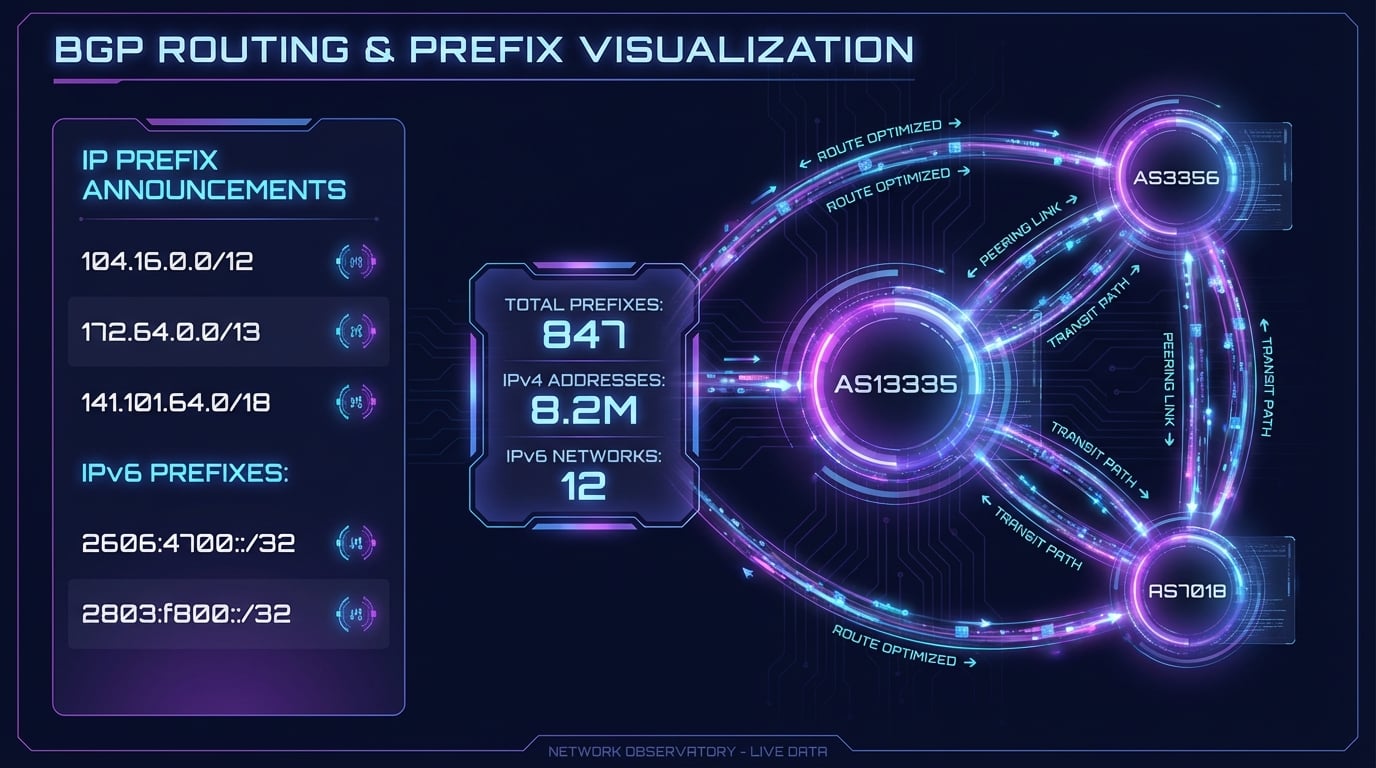
ASNs are essential for BGP (Border Gateway Protocol) — the routing protocol that connects all networks on the internet. When you browse a website, BGP uses ASN paths to route your traffic through multiple autonomous systems to reach its destination. For example, Cloudflare operates AS13335, Google uses AS15169, and Amazon Web Services uses AS16509.
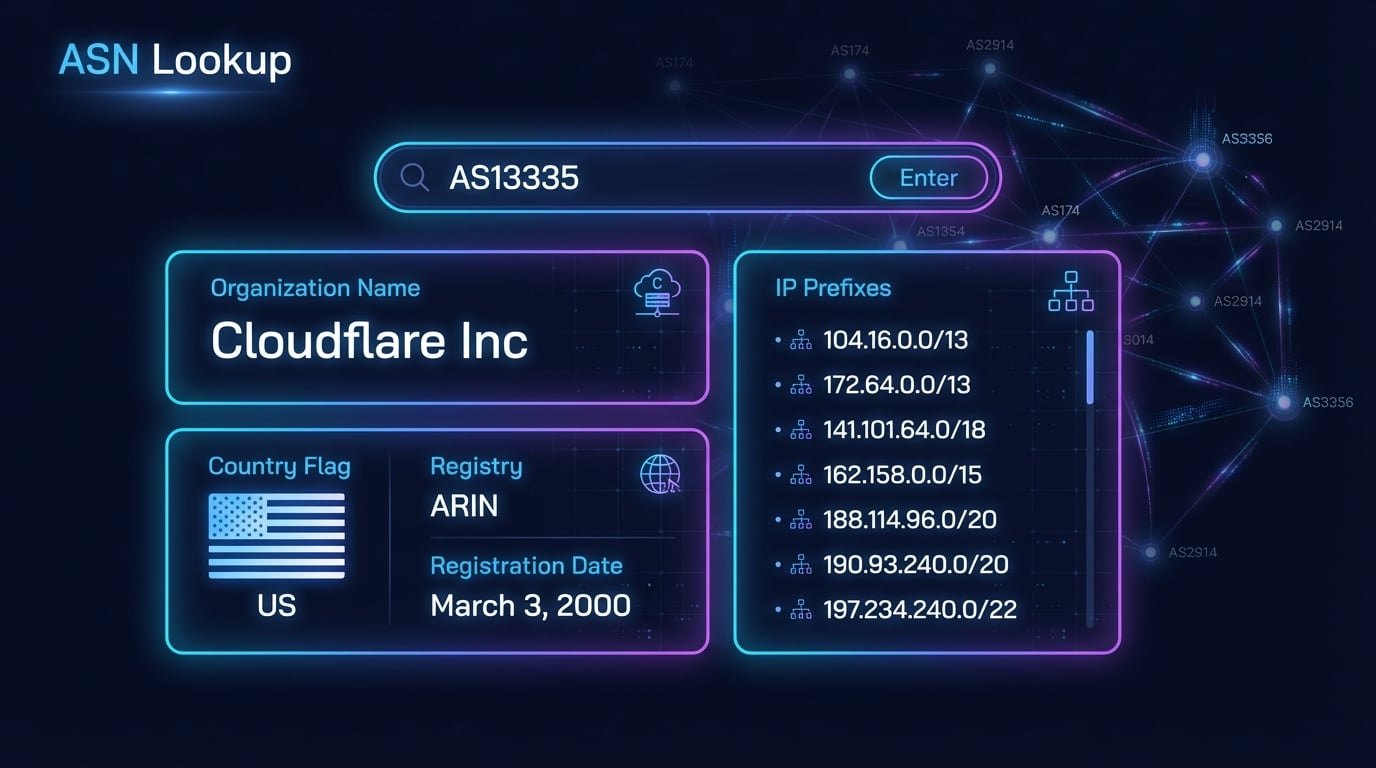
Our free ASN lookup tool uses the RDAP protocol to query real-time data from all five RIRs. You can look up any AS number to find the organization, country, registry, registration date, announced IP prefixes, and abuse contact. You can also enter an IP address and the tool will resolve it to the associated ASN automatically.
How ASN Lookup Works
Our ASN lookup tool queries multiple authoritative sources to provide comprehensive ASN information:
Parse Input
Enter an ASN (e.g., AS13335 or 13335) or an IP address (e.g., 1.1.1.1). IP addresses are resolved to their ASN via IPinfo before lookup.
Query RDAP
The ASN is looked up via RDAP (rdap.org), which automatically routes to the correct RIR (ARIN, RIPE, APNIC, LACNIC, or AFRINIC) for authoritative data.
Fetch Prefixes
Announced IPv4 and IPv6 prefixes are fetched from RIPEstat in parallel. Total IPv4 address count is calculated from prefix CIDR sizes.
Display Results
Organization name, country, registry, dates, prefixes, abuse contact, and address are displayed. BGPView serves as a fallback if RDAP is unavailable.
Advertisement
What ASN Lookup Reveals
When you look up an ASN, the tool returns detailed information about the autonomous system:
Organization Name
The registered organization that owns the ASN — typically an ISP, cloud provider, or enterprise. Sourced from the RDAP registrant entity vCard.
Country & Address
The registered country code and physical address of the organization. Extracted from RDAP entity vCard address fields.
Registry (RIR)
Which Regional Internet Registry allocated the ASN: ARIN, RIPE NCC, APNIC, LACNIC, or AFRINIC. Detected from the RDAP port43 field.
Registration & Update Dates
When the ASN was first registered and when the record was last updated. Helps determine the age and activity status of the network.
Announced Prefixes
IPv4 and IPv6 CIDR blocks announced by the ASN via BGP. Sourced from RIPEstat for real-time routing data.
Abuse Contact
The email address designated for reporting abuse originating from the ASN IP ranges. Essential for security teams filing abuse reports.
The Five Regional Internet Registries (RIRs)
ASNs and IP address blocks are allocated by five RIRs, each responsible for a geographic region. Our ASN lookup tool automatically queries the correct RIR via the RDAP bootstrap:
North America
Europe, Middle East, Central Asia
Asia-Pacific
Latin America, Caribbean
Africa
Advertisement

Well-Known Autonomous System Numbers
Here are some of the most well-known ASNs on the internet. Try looking them up with our tool:
| ASN | Organization | Type | RIR |
|---|---|---|---|
| AS15169 | Google LLC | Cloud/Content | ARIN |
| AS13335 | Cloudflare, Inc. | CDN/Security | ARIN |
| AS16509 | Amazon.com (AWS) | Cloud | ARIN |
| AS8075 | Microsoft Corp. | Cloud | ARIN |
| AS32934 | Meta Platforms | Content | ARIN |
| AS3356 | Lumen (Level 3) | Transit | ARIN |
| AS7922 | Comcast | ISP | ARIN |
| AS4134 | China Telecom | ISP | APNIC |
Who Uses ASN Lookup and Why?
ASN lookup tools are used across networking, security, and operations for a variety of purposes:
Network Engineers
Verify BGP peering, analyze AS paths, troubleshoot routing issues, and confirm prefix announcements. Essential for NOC teams managing internet-facing infrastructure.
Security Analysts
Investigate suspicious IP addresses, identify malicious network operators, perform threat attribution, and check ASN reputation for incident response.
Threat Intelligence
Map IP ranges to organizations, identify bulletproof hosting providers, track botnet C2 infrastructure, and enrich IoCs with network context.
System Administrators
Identify which organization owns an IP range, verify ISP information for access control, and configure firewall rules based on ASN blocking.
ISP Operations
Monitor announced prefixes, verify allocations, check peering partner details, and ensure route objects match announced prefixes.
Researchers & Students
Study internet topology, analyze BGP routing tables, research network consolidation trends, and prepare for networking certifications.
Advertisement
ASN Number Ranges Explained
Not all AS numbers are the same. IANA divides the ASN space into ranges with different purposes:
Public ASNs
- 1–64495 — 16-bit public ASNs (original pool)
- 131072–4199999999 — 32-bit public ASNs
- Used for internet BGP routing
- Globally unique, allocated by RIRs
Reserved & Private ASNs
- 64496–64511 — Reserved for documentation
- 64512–65534 — Private use (16-bit)
- 4200000000–4294967294 — Private use (32-bit)
- Not announced on the public internet
Related Network & IP Tools
Complement your ASN lookup with these free DNS Robot tools:
Look up geolocation, ISP, and ASN details for any IP address
Name the hosting provider behind any website from its ASN, headers and DNS
Look up domain registration, registrar, and owner details via RDAP
Find hostnames associated with any IP address via PTR records
Detect your ISP, ASN, and connection details automatically
Trace the network path hop-by-hop between you and any host
Calculate network ranges, subnet masks, and CIDR notation
Test port connectivity and service availability on any server
Check if an IP address is listed on spam or malware blacklists
Advertisement
Frequently Asked Questions About ASN Lookup
What is an ASN (Autonomous System Number)?
An ASN is a unique identifier assigned to a network or group of networks that participates in internet routing via BGP. ISPs, cloud providers, and large organizations each have ASNs. Examples: Cloudflare is AS13335, Google is AS15169.
How do I look up an ASN?
Enter any ASN (e.g., AS13335 or 13335) or IP address (e.g., 1.1.1.1) into the tool and click Lookup. The tool queries RDAP for ASN details and RIPEstat for announced prefixes. IP addresses are resolved to ASNs via IPinfo.
What is the difference between 16-bit and 32-bit ASNs?
Original ASNs were 16-bit (1–65535). As the internet grew, 32-bit ASNs (up to 4.29 billion) were introduced. Both work identically in BGP. The 16-bit range includes private ASNs (64512–65534) and documentation ASNs (64496–64511).
What are the five Regional Internet Registries?
ARIN (North America), RIPE NCC (Europe/Middle East/Central Asia), APNIC (Asia-Pacific), LACNIC (Latin America/Caribbean), and AFRINIC (Africa). Each allocates ASNs and IP addresses in their region.
What is BGP and how does it use ASNs?
BGP (Border Gateway Protocol) connects networks on the internet. Each AS announces its IP prefixes to neighbors via BGP. An AS path like '3356 13335' means traffic passes through Level3 to reach Cloudflare.
What are announced prefixes?
Announced prefixes are IP address blocks (CIDR ranges) that an AS advertises to the internet via BGP. Our tool shows both IPv4 and IPv6 prefixes sourced from RIPEstat, plus total IPv4 address count.
Can I look up an ASN from an IP address?
Yes. Enter any IP address and the tool resolves it to the associated ASN via IPinfo, then displays the full ASN details including organization, country, registry, and prefixes.
What is RDAP and why use it?
RDAP (Registration Data Access Protocol) is the modern replacement for WHOIS. It returns structured JSON, supports HTTPS, and works across all five RIRs. Our tool uses RDAP as primary with BGPView as fallback.
What is a private ASN?
Private ASNs (64512–65534 for 16-bit, 4200000000–4294967294 for 32-bit) are for internal use only and are not announced on the public internet, similar to RFC 1918 private IP addresses.
Is this ASN lookup tool free?
Yes, 100% free with no registration or API key required. It uses open data sources: RDAP (provided by all five RIRs), RIPEstat (provided by RIPE NCC), and BGPView as fallback.