









IP Lookup & IP Tracker
Look up any IP address: its location from two databases side by side, who owns it, and whether it's a home line, a phone, a VPN, Tor or a data center.
Finding your IP address…
What does an IP address lookup show?
An IP lookup (also called an IP locator, IP finder or IP checker) tells you where an address is, who it belongs to and what kind of connection it is. To check IP details, type any IPv4 or IPv6 address, or open the page to see your own.
Unlike most lookups, this one doesn't give you a single pin. It asks two independent location databases, IPinfo and DB-IP, and shows how far apart their answers are, because databases often disagree. The owner comes straight from the regional registry's record (RDAP, the successor to WHOIS), with the abuse contact.
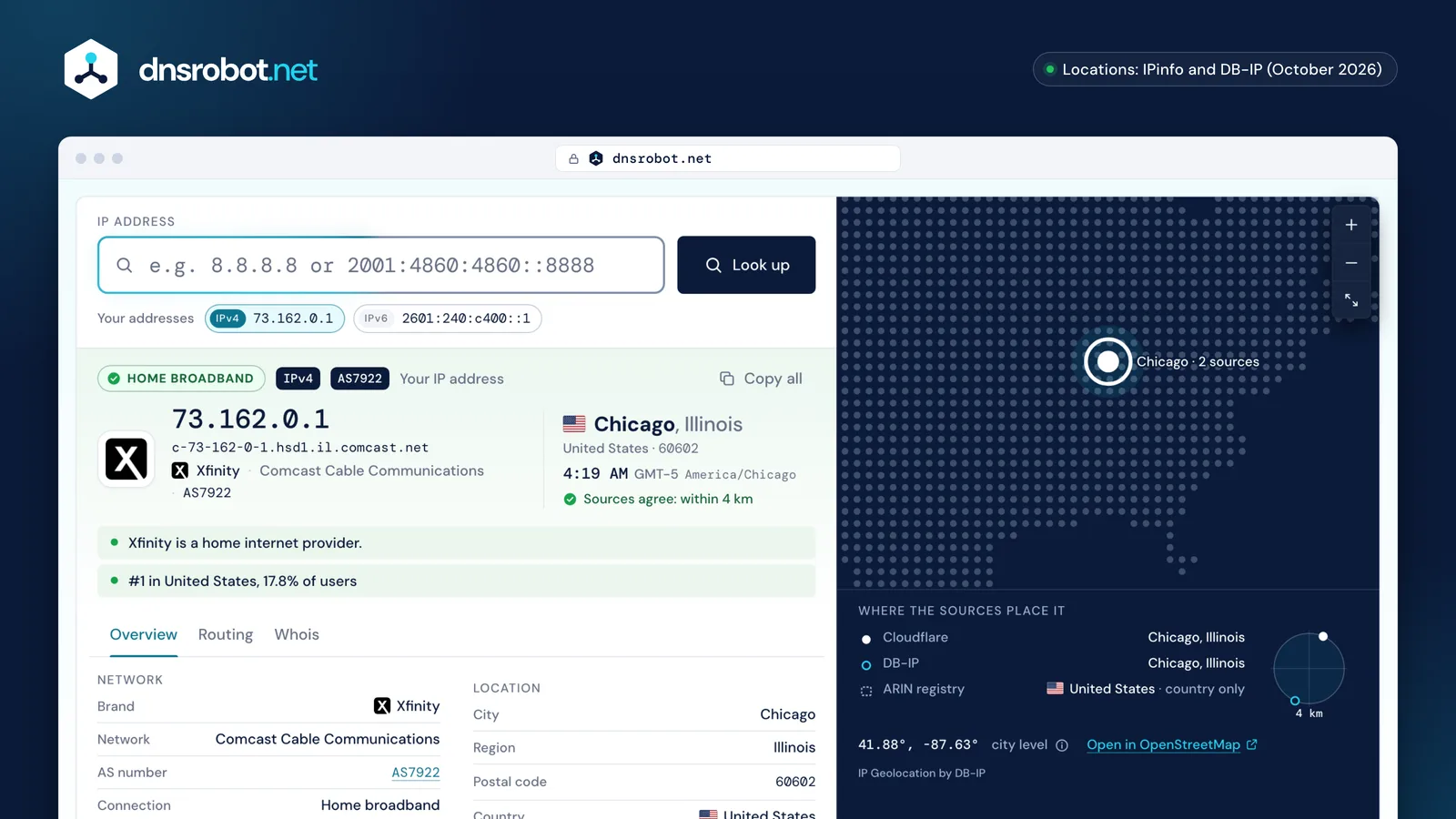
 Location agreementBoth databases on one map, with the distance between them. Close answers you can trust; far apart means the location is uncertain.Connection typeHome broadband, mobile, data center, VPN, Tor or Private Relay, with the reason we say so.NetworkThe network (AS number) that announces the address, its prefix and its reverse DNS name.RegistrationThe registry's record: the network block, its owner and where to report abuse.
How accurate is IP geolocation?
Accurate to the country, rough to the city. MaxMind, the largest geolocation vendor, estimates its data is 99.8% accurate at country level, but for US addresses only about 66% land within 50 km of the right city. Its free database does worse.
No database knows where an address is. They estimate it from registry records, the locations networks publish for their own addresses (geofeeds, RFC 8805), network latency measured from probes, and corrections people send in. Sources weigh these differently, so they often place the same address in different cities.
Published accuracy, United States
- MaxMind GeoIP: right country (all countries)
- 99.8%
- MaxMind GeoIP: within 50 km of the city
- 66%
- MaxMind's free GeoLite: within 50 km
- 55%
MaxMind's own estimates (support article and accuracy comparison, 2026). IPinfo says a CDN's test of about one million addresses found it 93% accurate at city level; it publishes no country figure.
How far off a city answer can be
- 66% Within 50 km of it
- A city further away
- ?No city at all
The share of US addresses that land inside the ring is the figure above; the rest are placed in a city further away or get no city.
Why sources disagree
Mobile networks
Phones across a wide area share the carrier's gateways, so the address shows where the gateway is.
Shared addresses (CGNAT)
Many customers share one public IPv4 address, which locates to the provider's gateway, very often a different city.
VPNs, proxies and relays
The address is the exit server's. The person can be anywhere.
Anycast
Addresses such as 8.8.8.8 and 1.1.1.1 answer from many data centers at once. Any single pin is wrong.
Moved address blocks
Providers move blocks between cities and countries; databases update monthly or slower.
Registry country
Where a block is registered isn't where it's used. Team Cymru warns its country code is not for geolocation.
Can an IP tracker find someone's exact location?
No. An IP address leads to a city or region at best, never to a household, a person or a street address. Only the internet provider keeps the records that link an address, at a given time, to a customer.
Providers normally release that to authorities under a subpoena or court order. In the US, a subpoena can compel the subscriber's name and address (18 U.S.C. § 2703). In the EU, the Court of Justice ruled in Breyer (2016) that a stored dynamic IP address can be personal data.
What an IP lookup can tell you
- The country, and roughly the city or region
- The internet provider or company that owns the address
- Whether it's a home line, mobile, data center, VPN or Tor
- Who to contact about abuse
What it can't
- A name, a street address or a phone number
- An exact position like GPS
- Who used a shared address (mobile, CGNAT, public Wi-Fi) at a given moment
- Where someone behind a VPN or Tor really is
- Name
- Not in any lookup
- Street address
- Not in any lookup
- Phone
- Not in any lookup
- City and region
 Chicago, Illinois
- Provider
- XfinityAS7922
- Connection
- Home broadband
Only the provider's records link the address to a customer
Who owns this IP address? (WHOIS IP lookup)
Every public address is registered by one of five regional internet registries (RIRs), which publish who holds each block. The registration card above reads that record over RDAP, the structured successor to WHOIS, straight from the registry: the block, its owner, the dates and the abuse contact.
The owner isn't always who uses the address: a hosting company or ISP holds the block and assigns it to its customers.
The five regional internet registries
- ARINUnited States, Canada and parts of the Caribbeanrdap.arin.net
- RIPE NCCEurope, the Middle East and Central Asiardap.db.ripe.net
- APNICAsia Pacificrdap.apnic.net
- LACNICLatin America and the Caribbeanrdap.lacnic.net
- AFRINICAfricardap.afrinic.net
Record over RDAP
How to report abuse from an IP address
- 1
Find the abuse contact
It's on the registration card above (the abuse role in the registry's record).
- 2
Collect the evidence
Logs or email headers with the exact date, time and time zone: shared addresses can't be traced without them.
- 3
Send a short report
The Report abuse button opens an email with the address and the block filled in.
- To
- abuse@example.net
- Subject
- Abuse report for 203.0.113.42
Hello,
I'm reporting abuse from 203.0.113.42 (network 203.0.113.0/24).
What happened:
When (date, time and time zone):
Evidence (logs, headers):
Thank you.
Home, mobile, data center, VPN or Tor: what kind of IP is it?
The type tells you more than the city. The tool decides it from the network that owns the address and public lists:
Home broadband
A consumer provider's address. The most reliable location, usually the right city or a nearby one.
What the pin means: Usually the right city
Mobile network
A carrier's gateway shared by many phones over a large area. The city is often far from the phone.
What the pin means: A wide area, not the phone
Data center
A cloud or hosting network: a server, or the exit of a VPN or proxy that runs there.
What the pin means: The server's location
Tor exit
On the Tor Project's own list of exit addresses, updated through the day. The user is somewhere else entirely.
What the pin means: Nowhere near the user
iCloud Private Relay
Apple publishes its relay addresses. Each stands for a coarse area, and always the user's real country.
What the pin means: A coarse area in the right country
Anycast
One address served from many places, like public DNS resolvers. It has no single location.
What the pin means: No single place
IP addresses that have no location
Some ranges never appear on the internet, so no database can place them. The tool says which one an address falls in:
| Range | What it is |
|---|---|
10.0.0.0/8172.16.0.0/12192.168.0.0/16 | Private networks: homes and offices (RFC 1918) |
100.64.0.0/10 | Inside a provider's carrier-grade NAT (RFC 6598) |
127.0.0.0/8::1 | Loopback: the device itself |
169.254.0.0/16fe80::/10 | Link-local: one local link only |
192.0.2.0/24198.51.100.0/24203.0.113.0/242001:db8::/323fff::/20 | Documentation and examples (RFC 5737, RFC 3849, RFC 9637) |
fc00::/7 | IPv6 unique local addresses (RFC 4193) |
224.0.0.0/4ff00::/8 | Multicast groups |
0.0.0.0/8240.0.0.0/4 | Reserved by IANA |
How to fix a wrong IP location
Each database is corrected on its own: MaxMind, IPinfo and DB-IP all take correction requests on their websites, and DB-IP refreshes when the registry record changes.
If you run the network, the lasting fix is a geofeed: a short CSV of your prefixes and their cities (RFC 8805), linked from your block's registry record with a geofeed: attribute (RFC 9632). Every database that reads geofeeds then picks it up.
- AnyoneCorrection formMaxMindIPinfoDB-IPOne database at a time
- If you run the networkgeofeed.csvYour registry recordEvery database that reads geofeeds
ip_prefix,alpha2code,region,city,postal_code
203.0.113.0/24,DE,DE-BE,Berlin,
2001:db8::/32,DE,DE-BE,Berlin,inetnum: 203.0.113.0/24
geofeed: https://example.com/geofeedIP lookup API
The same lookup as JSON, free, with CORS for browsers. Fields stay compatible with our older API; IPinfo's city answers are kept for our pages and server-side callers, and other websites' visitors get DB-IP's.
$ curl https://dnsrobot.net/api/ip-info$ curl "https://dnsrobot.net/api/ip-info?ip=8.8.8.8"
{
"query": "8.8.8.8", "hostname": "dns.google",
"city": "Mountain View", "country": "US", "anycast": true,
"network": { "asn": 15169, "label": "Google", "kind": "hosting" },
"dbip": { "city": "Mountain View", "lat": 37.422, "lon": -122.085, … },
"routing": { "prefix": "8.8.8.0/24", "registry": "arin", … },
"tor": false, …
}IP Lookup FAQ
What is an IP lookup?
How accurate is an IP address lookup?
Can an IP address tracker find someone's exact location?
Why do IP location databases disagree?
Is it legal to look up an IP address?
Can an IP lookup detect a VPN, proxy or Tor?
Who owns this IP address, and how do I report abuse?
Why does my IP show the wrong city?
Does the IP lookup work with IPv6?
What is the difference between an IP lookup and a WHOIS lookup?
Is the IP lookup free, and do you keep the addresses?
What is an anycast IP address?
More IP tools
What Is My IP
Your public IPv4 and IPv6 at once, with the network, location and a VPN check
What Is My ISP
Discover your ISP, ASN, and connection details
WHOIS Lookup
Look up domain registration, registrar, and owner details via RDAP
ASN Lookup
Look up Autonomous System Number details and IP ranges
Reverse DNS Lookup
Find hostnames associated with any IP address via PTR records
IP Blacklist Check
Check if an IP address is listed on spam or malware blacklists