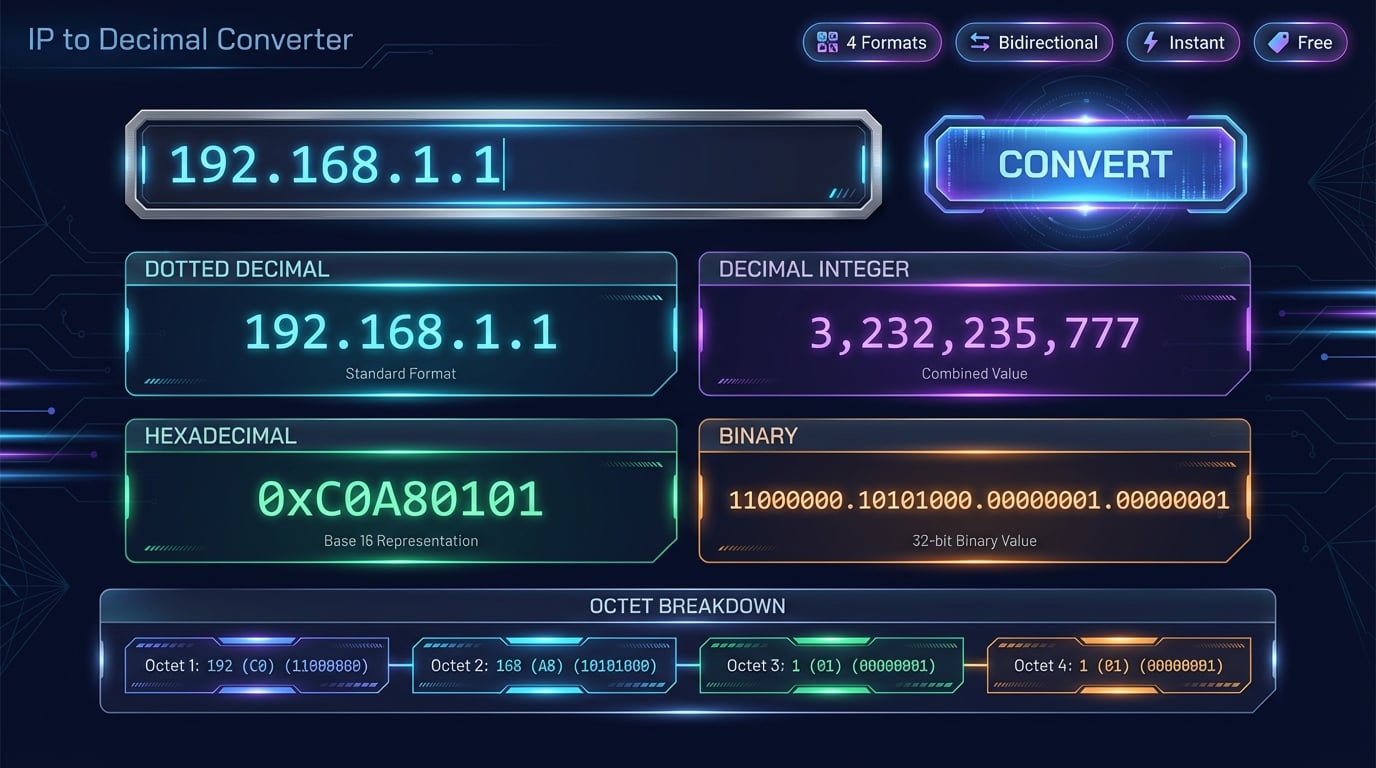
Convert any IP address to decimal, hexadecimal, and binary formats instantly. Supports bidirectional conversion — enter a decimal to IP address, hex, or binary value and get all other representations with a detailed octet breakdown.
Every IPv4 address is fundamentally a 32-bit unsigned integer — a number between 0 and 4,294,967,295. The familiar dotted-decimal notation (like 192.168.1.1) is simply a human-readable way to display this number by splitting it into four 8-bit groups called octets, each ranging from 0 to 255.
IP to decimal conversion takes a dotted-decimal IP address and calculates the equivalent single integer. For example, 192.168.1.1 becomes 3,232,235,777. The same 32-bit value can be expressed in four formats: dotted decimal, decimal integer, hexadecimal (0xC0A80101), and binary (11000000.10101000.00000001.00000001).
Our free IP address converter handles bidirectional conversion between all four formats. Enter an IP address, decimal number, hex value, or binary string and instantly get all other representations along with a detailed octet breakdown showing each byte in decimal, hexadecimal, and binary.
Converting an IP address to decimal is a straightforward mathematical process. Each octet occupies 8 bits of the 32-bit address, and its position determines a multiplier based on powers of 256 (since 2⁸ = 256).
Split the IP into four octets
192.168.1.1 → 192, 168, 1, 1
Multiply each octet by its positional value
192 × 256³ = 192 × 16,777,216 = 3,221,225,472
168 × 256² = 168 × 65,536 = 11,010,048
1 × 256¹ = 1 × 256 = 256
1 × 256⁰ = 1 × 1 = 1
Sum all values
3,221,225,472 + 11,010,048 + 256 + 1 = 3,232,235,777
Formula:
(O₁ × 256³) + (O₂ × 256²) + (O₃ × 256¹) + (O₄ × 256⁰)

The reverse process — converting a decimal to IP address — involves dividing the integer by powers of 256 to extract each octet. This is the inverse of the IP to decimal formula.
Divide by 16,777,216 (256³) for the first octet
floor(3,232,235,777 ÷ 16,777,216) = 192, remainder = 11,010,305
Divide remainder by 65,536 (256²) for the second octet
floor(11,010,305 ÷ 65,536) = 168, remainder = 257
Divide remainder by 256 for the third octet
floor(257 ÷ 256) = 1, remainder = 1
The remaining value is the fourth octet
Fourth octet = 1
Result:
3,232,235,777 → 192.168.1.1
In programming, bitwise operations are more efficient than division. The formula uses right-shift (>>>) and bitwise AND (& 0xFF) to extract each octet from the 32-bit integer. For instance, (n >>> 24) & 0xFF extracts the first octet.
An IPv4 address can be expressed in four standard formats. Each serves different purposes in networking, programming, and analysis. Our IP address converter supports all four formats with bidirectional conversion.
192.168.1.1The standard notation used in network configuration, routing tables, and everyday networking. Four octets (0-255) separated by dots.
Used in: Network configuration, DNS, firewall rules, server setup
3232235777A single unsigned 32-bit integer (0 to 4,294,967,295). Most compact numeric form for storage and mathematical operations.
Used in: Database storage, IP range queries, programming APIs
0xC0A80101Base-16 representation. Each pair of hex digits maps to one octet (C0 = 192, A8 = 168, 01 = 1). Prefix 0x indicates hex notation.
Used in: Packet analysis, low-level debugging, memory inspection
11000000.10101000.00000001.00000001Raw 32-bit representation. Each octet is 8 binary digits. Essential for understanding subnet masks and CIDR calculations.
Used in: Subnet calculations, bitwise operations, network education

Here are decimal, hexadecimal, and binary conversions for well-known IPv4 addresses frequently encountered in networking. Use these as quick references or to verify our IP to decimal converter results.
| IP Address | Decimal | Hex |
|---|---|---|
| 0.0.0.0 | 0 | 0x00000000 |
| 1.1.1.1 | 16,843,009 | 0x01010101 |
| 8.8.8.8 | 134,744,072 | 0x08080808 |
| 10.0.0.0 | 167,772,160 | 0x0A000000 |
| 127.0.0.1 | 2,130,706,433 | 0x7F000001 |
| 172.16.0.0 | 2,886,729,728 | 0xAC100000 |
| 192.168.0.0 | 3,232,235,520 | 0xC0A80000 |
| 255.255.255.255 | 4,294,967,295 | 0xFFFFFFFF |
While dotted-decimal notation is standard for human reading, there are many scenarios where converting an IP address to decimal or other formats is essential for network professionals and developers.
Store IP addresses as 4-byte integers instead of 15-character strings. Enables efficient range queries with BETWEEN and uses 73% less storage. MySQL's INET_ATON() and PostgreSQL's inet type handle this natively.
Some firewalls and access control lists accept IP ranges as integer ranges. Converting to decimal makes it easy to define rules like 'allow 3232235520 to 3232235775' (covering 192.168.0.0/24).
Low-level socket APIs (C, Rust, Go) represent addresses as 32-bit integers in network byte order. Functions like inet_aton() and inet_ntoa() convert between formats for socket programming.
Checking if an IP falls within a CIDR range becomes a simple integer comparison. For 192.168.1.0/24: check if decimal is between 3,232,235,776 and 3,232,236,031.
Network protocol analyzers like Wireshark display IP headers in hexadecimal. Understanding hex-to-IP conversion is essential for reading raw packet dumps and debugging network issues.
GeoIP services, threat intelligence feeds, and abuse databases often accept or return IPs as integers. Converting between formats ensures compatibility across different API specifications.

Our IP to decimal converter is part of a comprehensive suite of networking and conversion tools. Explore related utilities for IP address management, network analysis, and DNS lookups.
IPv4 to IPv6 Converter
Convert IPv4 addresses to IPv6-mapped format
IPv6 Compression Tool
Compress and expand IPv6 addresses (RFC 5952)
Subnet Calculator
Calculate CIDR subnets, ranges, and broadcast addresses
IP Lookup
Look up geolocation, ISP, and ASN for any IP
Domain to IP
Find the IP address of any website or domain
What Is My IP
Find your public IPv4 and IPv6 addresses
DNS Lookup
Check all DNS records of any domain online
Reverse DNS Lookup
Look up PTR records for any IP address
IP to decimal conversion transforms a dotted-decimal IPv4 address (like 192.168.1.1) into a single 32-bit unsigned integer (3,232,235,777). Every IPv4 address is fundamentally a 32-bit number — the four octets are a human-readable way to represent it. The conversion multiplies each octet by its positional value (256³, 256², 256¹, 256⁰) and sums the results.
Split the IP into four octets, multiply each by its positional power of 256, and sum: (O₁ × 256³) + (O₂ × 256²) + (O₃ × 256¹) + (O₄ × 256⁰). For 192.168.1.1: (192 × 16,777,216) + (168 × 65,536) + (1 × 256) + (1 × 1) = 3,232,235,777.
Divide the decimal by 16,777,216 (256³) for the first octet, then divide the remainder by 65,536 (256²) for the second, by 256 for the third, and the final remainder is the fourth octet. Alternatively, use bitwise operations: (n >>> 24) & 0xFF, (n >>> 16) & 0xFF, (n >>> 8) & 0xFF, n & 0xFF.
Common uses include: database storage (integers use less space and enable efficient range queries), firewall rules that accept integer ranges, low-level network programming with socket APIs, IP range comparison using simple integer math, packet analysis where addresses appear in hexadecimal, and API integration with services that use integer IP formats.
The decimal value of 192.168.1.1 is 3,232,235,777. In hexadecimal it is 0xC0A80101, and in binary it is 11000000.10101000.00000001.00000001. This is a private IP address commonly used as a default router gateway on home networks.
The maximum decimal value is 4,294,967,295 (2³² − 1), corresponding to the broadcast address 255.255.255.255. In hexadecimal, this is 0xFFFFFFFF. The minimum value is 0, which corresponds to 0.0.0.0 (the unspecified address). The full valid range spans 0 to 4,294,967,295.
IPv6 addresses are 128-bit numbers, so they can theoretically be converted to decimal, but the result can be up to 39 digits long (up to 340 undecillion). Standard 64-bit integers cannot hold this value — you need big integer math. This tool focuses on IPv4 (32-bit). For IPv6 tools, use our IPv6 Compression Tool or IPv4 to IPv6 Converter.
Dotted decimal (192.168.1.1) splits the 32-bit address into four 8-bit octets separated by dots. Decimal integer (3,232,235,777) represents the same value as a single number. Dotted decimal is used for network configuration; decimal integer is used for database storage, programming, and IP range calculations.
Hexadecimal (base 16) represents each 4-bit nibble as a digit 0-F. For 192.168.1.1: C0.A8.01.01 → 0xC0A80101. It is used in packet analysis and debugging. Binary (base 2) shows each of the 32 bits as 0 or 1, often dot-separated by octet. Binary is essential for subnet mask calculations and CIDR operations.
Yes, completely free with no limits, no registration, and no ads. All conversions happen in your browser via client-side JavaScript — your IP addresses are never sent to any server. It supports bidirectional conversion between IP, decimal, hexadecimal, and binary formats.