
What Is IPv6 to IPv4 Conversion?
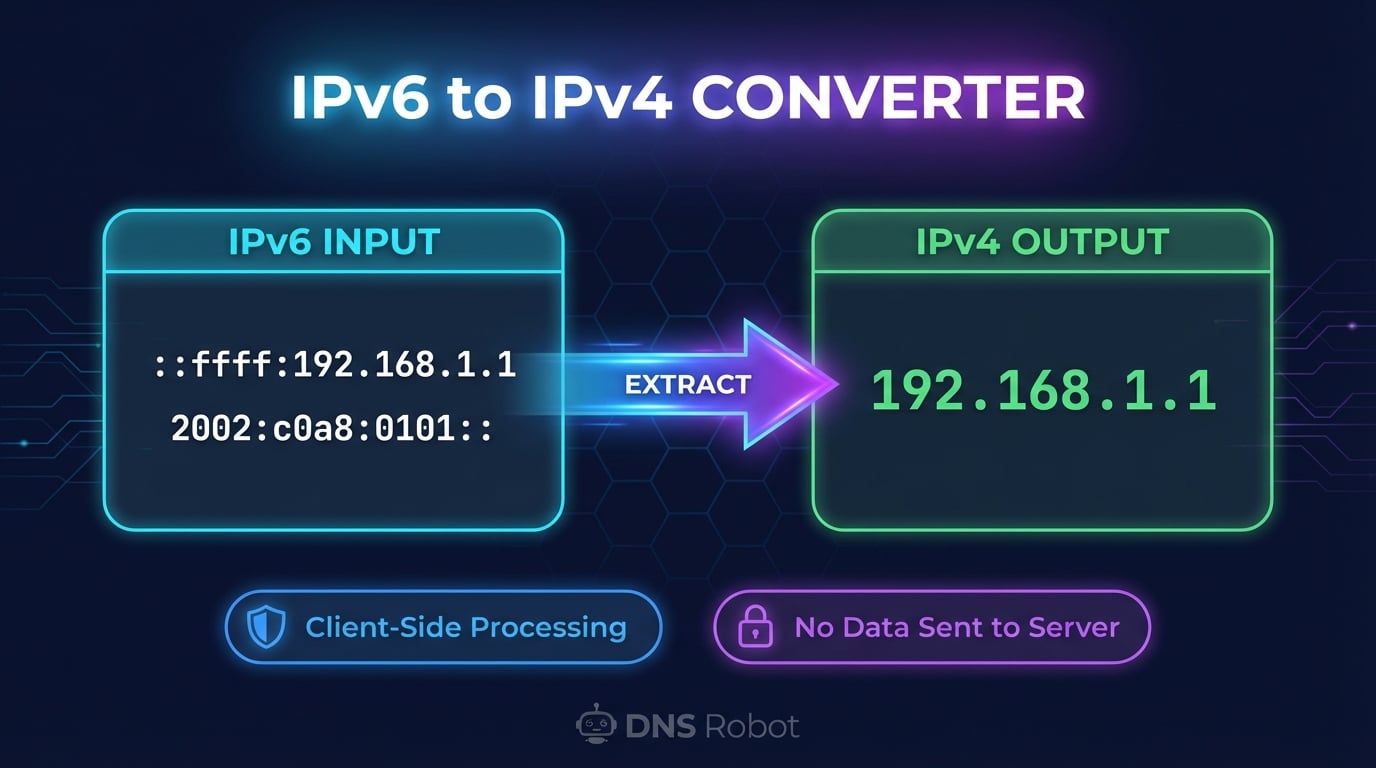
IPv6 to IPv4 conversion is the process of extracting an embedded IPv4 address from a special IPv6 address format. Not all IPv6 addresses can be converted — only those specifically designed to carry IPv4 information inside them. These are IPv6-mapped addresses (::ffff:x.x.x.x) and 6to4 tunnel addresses (2002:xxxx:xxxx::).
These hybrid formats exist because the internet is transitioning from IPv4 (4.3 billion addresses) to IPv6 (340 undecillion addresses), and both protocols need to coexist during the transition. Dual-stack servers, load balancers, and firewalls frequently log IPv4 connections using the IPv6-mapped notation — making this converter essential for network administrators analyzing logs.
Our converter runs entirely in your browser. Enter any IPv6 address and it instantly extracts the embedded IPv4 address, or tells you if the address is native IPv6 with no embedded IPv4 equivalent. Use our IPv4 to IPv6 converter for the reverse operation.
Supported IPv6 Input Formats
The converter recognizes two IPv6 address formats that contain embedded IPv4 addresses:
IPv6-Mapped (::ffff:)
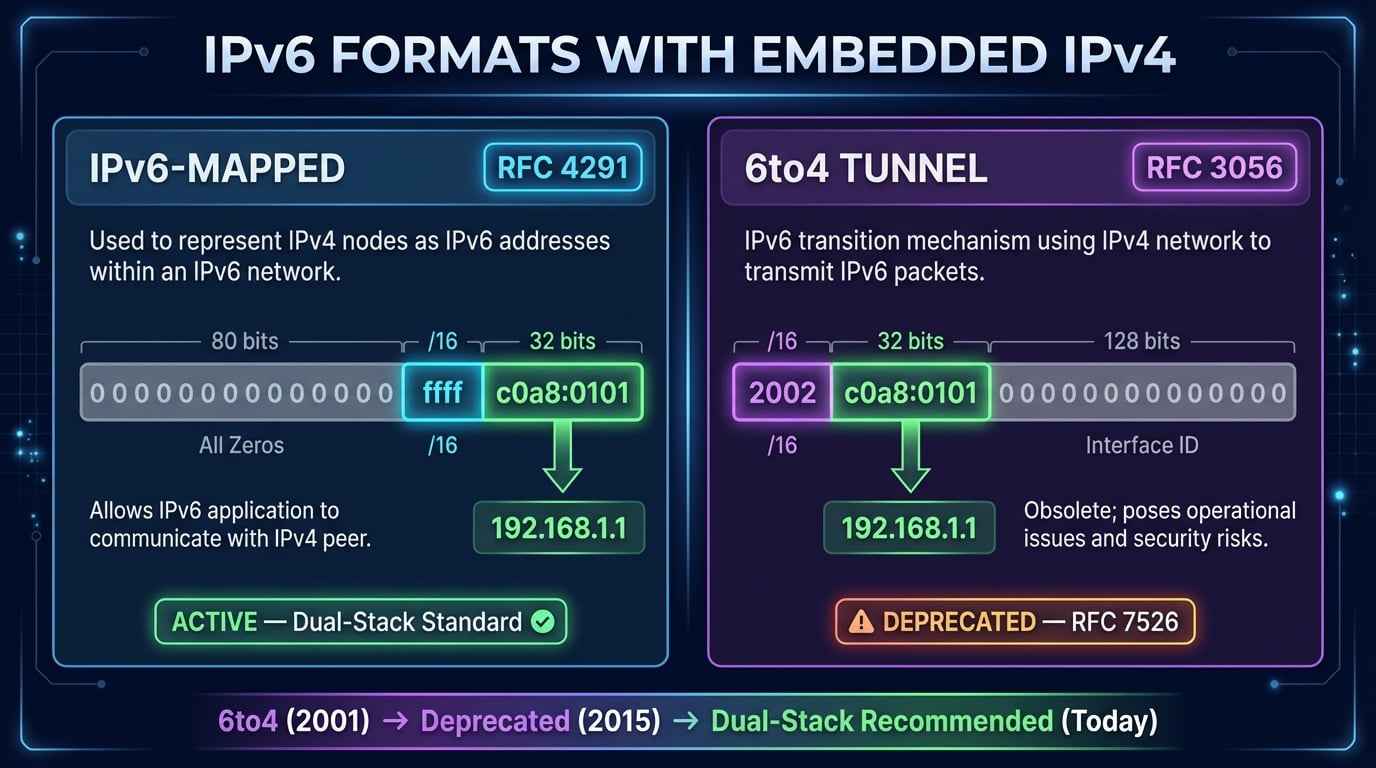
Defined in RFC 4291, these addresses embed IPv4 in the last 32 bits. The format is ::ffff: followed by the IPv4 address in dotted-decimal or hexadecimal notation.
6to4 Tunnel (2002::)
Defined in RFC 3056 (deprecated by RFC 7526), these addresses encode the IPv4 address in the 2nd and 3rd 16-bit groups after the 2002: prefix.
Native IPv6 addresses (like 2001:db8::1 or fe80::1) do not contain embedded IPv4 addresses and cannot be converted. The IPv6 address space is 2128 — vastly larger than IPv4's 232 — so there is no one-to-one mapping between arbitrary IPv6 and IPv4 addresses.
Advertisement
How IPv6 to IPv4 Conversion Works
The conversion is a straightforward mathematical extraction — no network lookups or databases involved. Here is how each format is decoded:
Detect Format
The tool checks if the address starts with ::ffff: (IPv6-mapped) or 2002: (6to4 tunnel). If neither, it reports that the address is native IPv6 and cannot be converted.
Extract Hex Groups
For IPv6-mapped: extract the last 32 bits (last two 16-bit groups). For 6to4: extract bits 16-47 (the two groups after the 2002: prefix).
Convert Hex to Decimal
Each 16-bit hex group is split into two 8-bit octets and converted to decimal. For example, c0a8 becomes 192 (0xc0) and 168 (0xa8).
Format as IPv4
The four decimal octets are joined with dots to produce the standard IPv4 dotted-decimal notation: 192.168.1.1
IPv4 vs IPv6: Why Both Still Exist
IPv4's 4.3 billion addresses ran out years ago, yet most of the internet still runs on IPv4 alongside IPv6. The coexistence of both protocols is why transition mechanisms like IPv6-mapped addresses and 6to4 tunnels were created in the first place.
IPv4
- 32-bit addresses (e.g., 192.168.1.1)
- ~4.3 billion unique addresses
- Universal ISP and device support
- Address pool exhausted — relies on NAT
- No built-in security (IPsec optional)
IPv6
- 128-bit addresses (e.g., 2001:db8::1)
- 340 undecillion unique addresses
- Built-in IPsec security
- No NAT needed — end-to-end connectivity
- ~45% global adoption (growing)
Use our DNS Lookup tool to check if a domain has both A (IPv4) and AAAA (IPv6) records. The What Is My IP tool detects whether your connection uses IPv4, IPv6, or dual-stack.
Advertisement
IPv6 Transition Mechanisms Explained
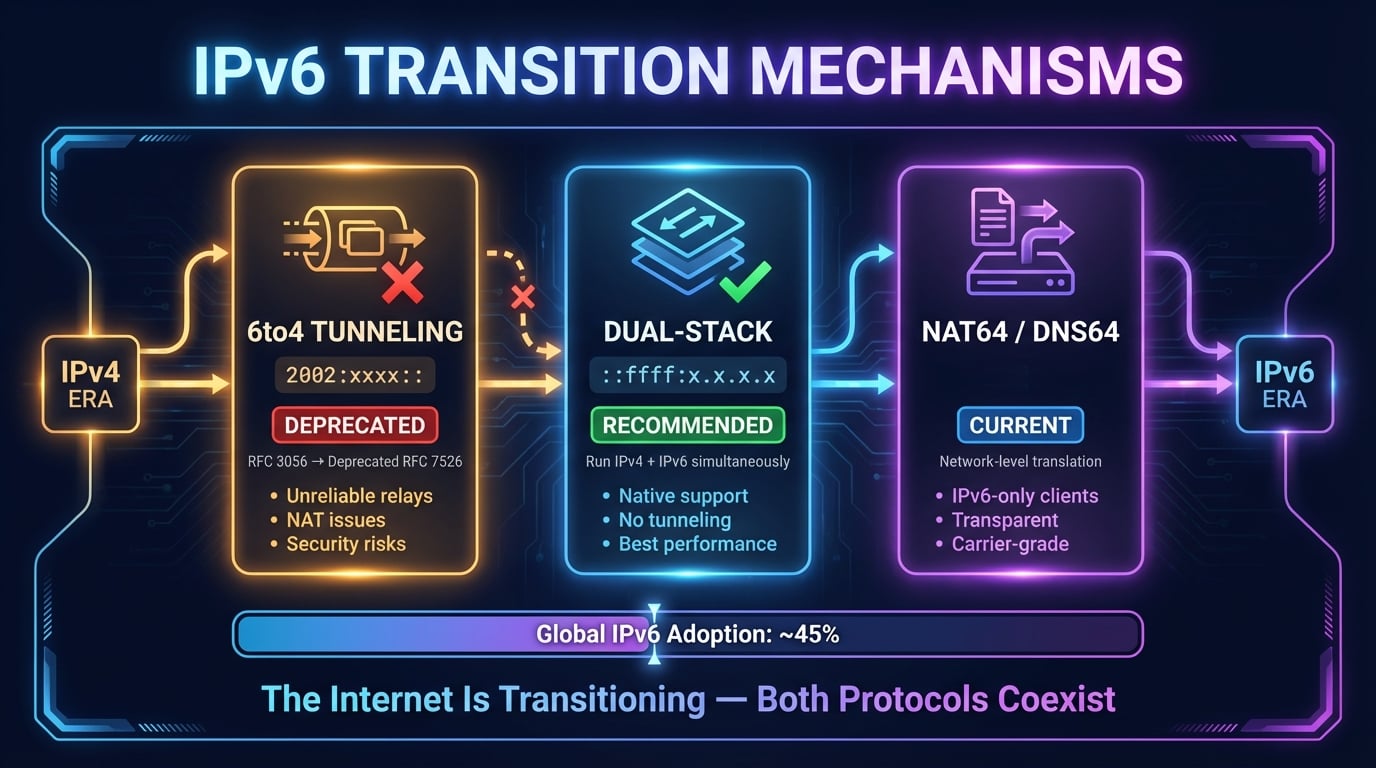
Several mechanisms were developed to help the internet transition from IPv4 to IPv6. Understanding these helps explain why IPv6 addresses sometimes contain IPv4 information:
Dual-Stack
Running IPv4 and IPv6 simultaneously on the same interface. The recommended approach. IPv6-mapped addresses (::ffff:) represent IPv4 connections in dual-stack applications.
6to4 Tunneling
Encapsulates IPv6 packets inside IPv4 for transport across IPv4 networks. Uses the 2002: prefix. Deprecated since 2015 (RFC 7526) due to reliability issues.
NAT64 / DNS64
Translates between IPv6-only and IPv4-only networks. The network handles the translation transparently — no special address formats in application logs.
Related IP & Network Tools
Complement your IPv6-to-IPv4 conversion with these free networking tools:
Convert IPv4 addresses to IPv6-mapped and 6to4 tunnel formats.
Compress and expand IPv6 addresses using zero-suppression rules.
Convert IP addresses to decimal, hexadecimal, and binary formats.
Detect your public IPv4 and IPv6 addresses instantly.
Look up geolocation, ISP, ASN, and organization for any IP.
Query A (IPv4) and AAAA (IPv6) records for any domain.
Find the hostname associated with any IPv4 or IPv6 address.
Test connectivity and latency to any IPv4 or IPv6 host.
Advertisement
Frequently Asked Questions About IPv6 to IPv4 Conversion
How do I convert an IPv6 address to IPv4?
Enter an IPv6-mapped address (::ffff:192.168.1.1) or a 6to4 tunnel address (2002:c0a8:0101::) into the converter. Only IPv6 addresses with embedded IPv4 information can be converted — native IPv6 addresses have no IPv4 equivalent.
Can any IPv6 address be converted to IPv4?
No. Only IPv6-mapped (::ffff:) and 6to4 (2002:) addresses contain embedded IPv4 data. Native IPv6 addresses use a 128-bit space that is vastly larger than IPv4's 32-bit space — there's no one-to-one mapping.
What is an IPv6-mapped IPv4 address?
A format defined in RFC 4291: ::ffff:x.x.x.x. The first 80 bits are zero, the next 16 are ffff, and the last 32 contain the IPv4 address. Used by dual-stack systems to represent IPv4 connections in IPv6 notation.
What is a 6to4 tunnel address?
A format defined in RFC 3056: 2002:xxxx:xxxx:: where xxxx:xxxx is the IPv4 address in hex. Deprecated since RFC 7526 (2015) due to relay reliability issues, NAT problems, and security concerns.
Why was 6to4 deprecated?
RFC 7526 deprecated 6to4 due to unreliable relay routers, NAT traversal failures, asymmetric routing, and security vulnerabilities. Modern alternatives include native IPv6, 464XLAT, NAT64, and DS-Lite.
How does the conversion work technically?
For ::ffff:c0a8:0101, extract the last 32 bits and convert each hex byte to decimal: c0=192, a8=168, 01=1, 01=1 → 192.168.1.1. For 6to4, extract bits 16-47 (after 2002:) and do the same conversion.
What is dual-stack networking?
Running IPv4 and IPv6 simultaneously on the same interface. IPv6-mapped addresses (::ffff:) represent IPv4 connections in dual-stack applications. This is the recommended transition approach.
Is this converter free and private?
Yes. The conversion runs entirely in your browser using client-side JavaScript. No data is sent to any server. It's completely free with no registration or rate limits.