
What Is a Website Hosting Checker?
A hosting checker tells you which company runs the servers behind a website. Every site lives on a machine owned by someone: a shared host such as Hostinger or Bluehost, a managed WordPress platform such as WP Engine or Kinsta, a cloud such as AWS or Google Cloud, or a site builder such as Shopify or Wix. The domain name hides that detail. The hosting checker uncovers it from public data, in a few seconds.
This website hosting checker does more than name the owner of an IP address. It follows the domain to its server, reads the network the IP address belongs to, inspects the HTTP headers and CNAME records that hosting platforms leave behind, checks the nameservers and fingerprints the page itself. It then weighs every signal and shows you how confident the answer is and why, so you can tell a certain match from an educated guess.
Alongside the host you get the rest of the stack: the CDN or proxy in front of the site, the CMS or site builder, the email provider from the MX records, the domain registrar from RDAP and the SSL certificate issuer.
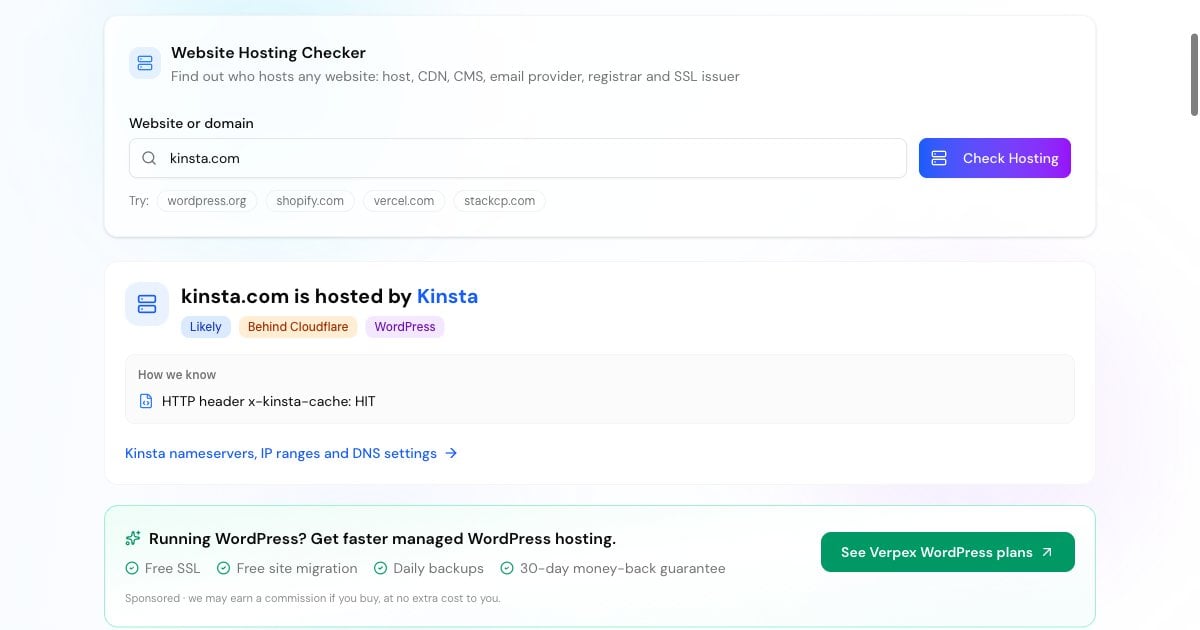
How to Find Out Who Is Hosting a Website
Checking who hosts a website takes four steps:
Type or paste a domain or a full URL, such as example.com or https://www.example.com/page. The checker strips the path and the www prefix for you.
The result names the hosting provider with a confidence rating: High confidence, Likely or Possible. If the site sits behind a CDN such as Cloudflare, the headline says so.
Under "How we know" you see each signal that matched: the IP network (ASN), an HTTP header, a CNAME record, a page fingerprint or a nameserver.
The details grid adds the IP address, server location, CDN, CMS, web server, email provider, registrar, SSL issuer and nameservers. Copy the page link to share the result: it carries ?domain= in the URL.
Advertisement
How the Hosting Checker Detects a Web Host
No single record proves who hosts a site, so the checker collects five kinds of evidence and scores them. Stronger signals count for more:
The site's IP address is looked up in the global routing table via Team Cymru. If it belongs to a host's autonomous system, such as AS47583 for Hostinger or AS24940 for Hetzner, that is the strongest single signal.
Many platforms stamp their responses: x-kinsta-cache for Kinsta, x-vercel-id for Vercel, x-nf-request-id for Netlify, host-header for WordPress.com. These reveal the host even behind a CDN.
When www points to a platform hostname, such as example.wpengine.com or shops.myshopify.com, the CNAME names the host directly.
Hosted-only builders such as Shopify, Wix and Squarespace leave unmistakable markup. A Shopify store can only be hosted by Shopify.
Nameservers such as ns1.dns-parking.com (Hostinger) or ns1.siteground.net show where DNS is managed. That is often, but not always, the same company as the host.
Some companies share one network: Bluehost and HostGator both run on Newfold's Unified Layer. When the network is shared, the nameservers decide, and the result lists the alternatives.
Why Some Websites Show Cloudflare Instead of the Real Host
If a site uses Cloudflare, Fastly, Akamai, Sucuri or another reverse proxy, visitors never connect to the web server directly. The domain resolves to the proxy's IP address, so a plain IP lookup names the CDN, not the host. That is why other tools often answer "Cloudflare" for millions of sites that are really hosted somewhere else.
The hosting checker reports the CDN separately and keeps looking for the origin host. Platform headers still pass through the proxy (Kinsta, WP Engine and Shopify all stamp theirs), CNAME records still point at the platform, and nameservers still reveal the DNS provider. When none of those signals exist, the checker tells you plainly that the real host is hidden, instead of guessing.
Hiding the origin is deliberate: it protects the server from direct attacks. If you need the host of a Cloudflare-protected site to report abuse, use Cloudflare's own abuse form; Cloudflare forwards reports to the hosting provider.
Headers: platform headers such as x-kinsta-cache survive the proxy
CNAME: www often points to the platform, e.g. example.wpengine.com
Nameservers: the DNS provider is visible even when the IP is not
Page markup: hosted builders like Shopify identify themselves
Advertisement
Find a Website's Host Manually With dig, whois and curl
You can reproduce every check from a terminal. These are the same lookups the tool runs, one by one. Replace example.com with the site you are investigating:
dig +short example.com Awhois -h whois.cymru.com " -v $(dig +short example.com A | head -1)"curl -sI https://example.com | grep -iE 'server|x-powered-by|via|x-'dig +short example.com NS
dig +short www.example.com CNAMEdig +short example.com MXWeb Host vs Domain Registrar vs DNS Provider
The most common mix-up when checking who owns a site's infrastructure: a website usually involves three different companies, and the hosting checker shows all three:
Web host
Runs the server that stores and serves the website files. This is what the headline names. Moving a site means moving it here.
Domain registrar
Where the domain name was bought and is renewed, such as Namecheap, GoDaddy or Cloudflare Registrar. Shown from RDAP. See the full record with the WHOIS lookup.
DNS provider
Answers DNS queries for the domain, shown as the nameservers. Often the registrar or the host, sometimes a separate service such as Cloudflare or Route 53. Check them with the NS lookup.
Advertisement
What You Can Do With the Result
Knowing what host a site is on answers practical questions:
Choose a host: a competitor's site is fast and reliable? Now you know where it lives
Plan a migration: confirm where a client's site is hosted before moving it
Report abuse: phishing and spam reports go to the hosting provider, not the registrar
Audit a stack: check the CDN, CMS, email provider and SSL issuer in one pass
Due diligence: before buying a website or domain, see how it is really run
Every IPv4 and IPv6 address of a domain with network details
The full technology stack: CMS, frameworks, analytics and more
Mail servers and their priorities for any domain
Certificate chain, expiry date and issuer details
Everything about the network that owns an IP address
Every response header with a security grade