What Does a Meta Tag Checker Do?
Meta tags live in a page's <head> and tell search engines and social networks what the page is about: the title shown in Google, the description under it, whether the page may be indexed, which URL is the original, and the image and text used when someone shares the link.
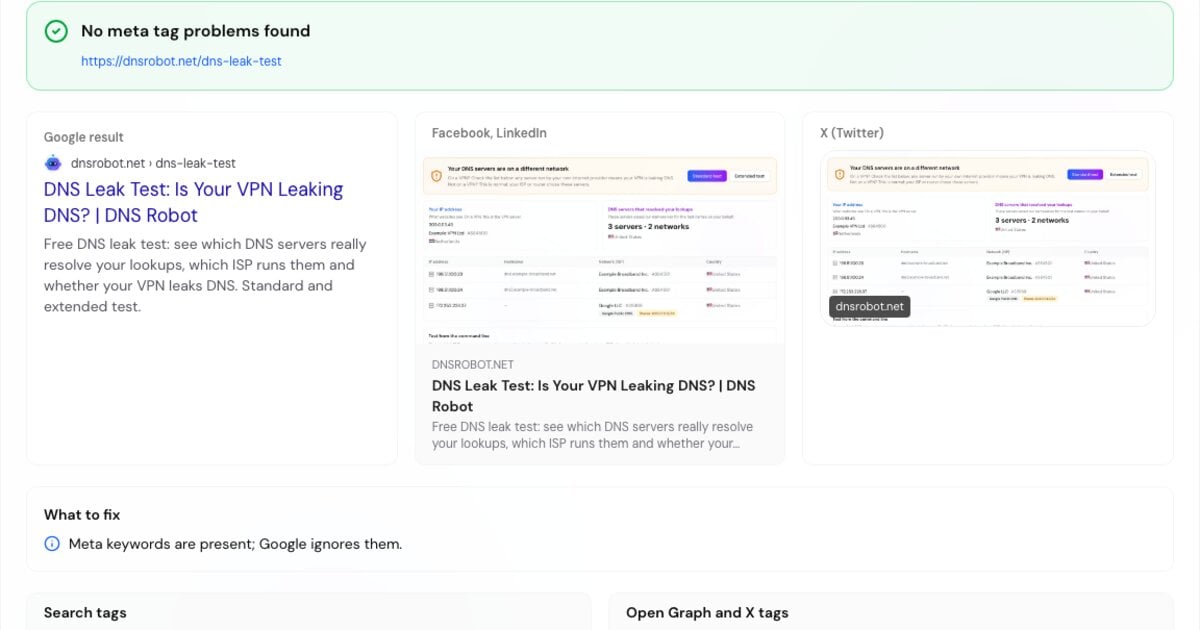
This checker fetches the page the way a crawler does, reads every one of those tags, and shows the result three ways: a list of problems with fixes, a preview of the Google result and the Facebook and X cards, and a table of every tag found.
How to Check Your Meta Tags
Paste the full address of the page, such as https://example.com/blog/post. Each page has its own tags, so check the pages that matter most.
Errors stop the page from showing properly; warnings cost clicks; notes are good-to-know. Each one names the tag and what to change.
The Google preview cuts the title and description where Google usually does. The social cards use the same image and text Facebook, LinkedIn and X will use.
Update the tags in your CMS or template, then run the check again. Social networks cache old cards, so refresh them in their own debug tools too.
Advertisement
The Meta Tags That Matter for SEO
<title> is usually the blue headline in Google. Keep it unique per page, lead with the main keyword, and stay around 50–60 characters.
Not a ranking factor, but often the snippet under your title. Write 120–160 characters that make people want to click.
noindex keeps a page out of search results. It can also come from the X-Robots-Tag HTTP header, which this checker reads too.
<link rel="canonical"> names the original URL when several URLs show the same content. Use one absolute URL per page.
<meta name="viewport"> makes the page fit phone screens. Google indexes the mobile version first, so every page needs it.
<html lang="en"> tells browsers and search engines the page's language, and helps screen readers pronounce it.
Open Graph and X Card Tags
When someone shares your link on Facebook, LinkedIn, WhatsApp, Slack or Discord, the preview comes from Open Graph tags. X reads its own twitter: tags and falls back to Open Graph for the title, description and image. Without them, platforms guess, often with the wrong image or no image at all.
Use an image of 1200×630 pixels (a 1.91:1 ratio) with an absolute https:// URL. The checker downloads the start of the image to report its real size and flags images that are broken, too small or the wrong shape.
<meta property="og:title" content="Page title">
<meta property="og:description" content="One or two sentences about the page.">
<meta property="og:image" content="https://example.com/og-image.png">
<meta property="og:url" content="https://example.com/page">
<meta property="og:type" content="website">
<meta name="twitter:card" content="summary_large_image">
Advertisement
How Long Should a Title and Meta Description Be?
Google doesn't count characters: it cuts titles at roughly 600 pixels and descriptions at about two lines, then adds an ellipsis. In practice that means about 50–60 characters for titles and up to about 160 characters for descriptions on desktop, and fewer on mobile.
Google also rewrites titles and descriptions when it thinks another text matches the search better. A clear, accurate title that matches the page's H1 is the best way to keep yours.
Common Meta Tag Mistakes
The same title on every page. Each page should have its own title that describes that page, not just the site name.
A leftover `noindex`. Staging sites often ship with
noindexstill set, which keeps the whole site out of Google.A canonical pointing to the wrong page, such as the homepage or the http version, which tells Google to ignore the page you're checking.
A relative `og:image`. Social networks need the full
https://URL;/images/og.pngwon't load.An image that's too small. Below 600×315 pixels, Facebook shows a small thumbnail instead of a large card.
Hreflang without a self-reference or return links. Every language version must list itself and all the others, or Google may ignore the set.
Relying on meta keywords. Google has ignored the keywords tag since 2009. It does no harm, but it does nothing either.
Advertisement
Checking Hreflang Tags
Sites in several languages use <link rel="alternate" hreflang="…"> to point Google to each version. The checker lists every hreflang link it finds and checks three things: that each code is a valid language (and optional region) code like en, de-AT or pt-BR, that the page lists itself, and that an x-default fallback exists.
To confirm the links are reciprocal, check each language version in turn: each must list the same set of URLs.
More SEO Tools
Check the rest of your technical SEO with these free tools: