What Does a Sitemap Checker Do?
An XML sitemap lists the pages you want search engines to find, with optional dates that tell them when a page last changed. Google reads it to discover and recrawl URLs, but only if the file is valid, reachable and lists pages that actually work.
This checker finds your sitemap the way a crawler does, validates it against the sitemaps.org protocol and Google's rules, and then tests a sample of the URLs it lists. You see in one report whether the file parses, whether it's within the limits, and whether it points crawlers at broken, redirecting or blocked pages.
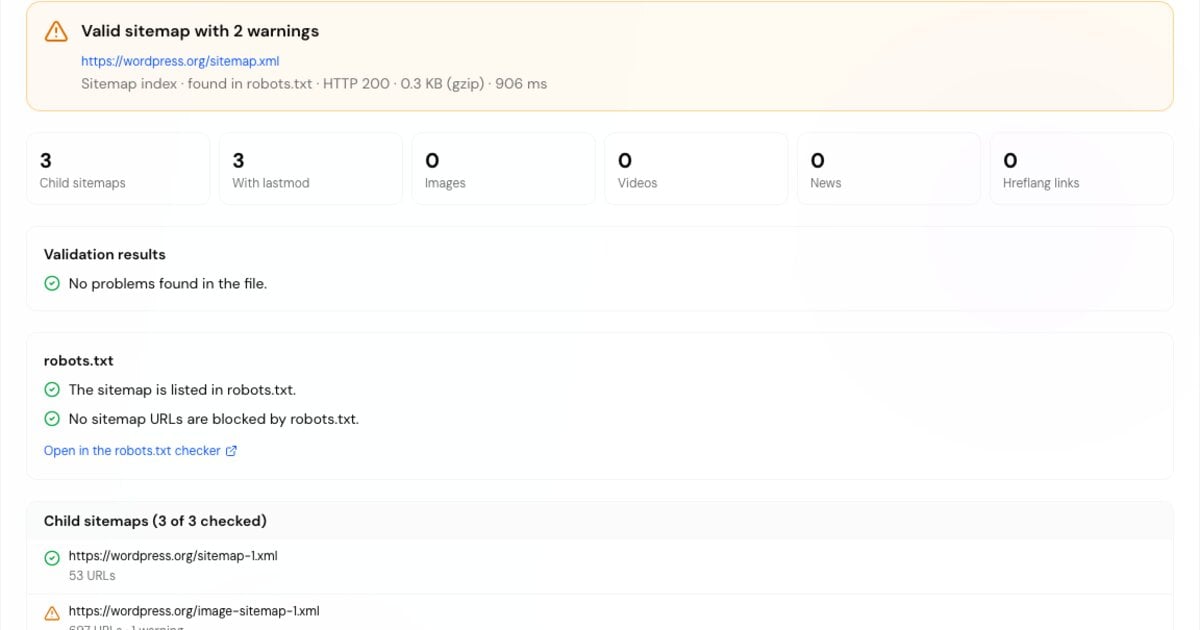
How to Check Your Sitemap
Type example.com to let the checker find the sitemap, or paste the exact address, such as https://example.com/sitemap_index.xml.
The checker reads the Sitemap: lines in robots.txt first, then tries common locations like /sitemap.xml, /sitemap_index.xml and /wp-sitemap.xml.
It parses the XML, checks the limits and namespace, and reviews every URL and lastmod date. For a sitemap index it opens the first 10 child sitemaps.
Ten URLs spread across the sitemap are fetched to catch 404s, redirects, noindex tags and canonicals that point elsewhere.
Advertisement
What the Sitemap Checker Looks For
Each check maps to a reason Google Search Console can reject or ignore a sitemap:
Unclosed tags or a bare & in a URL break the whole file. The checker shows the exact line and column.
A sitemap may hold 50,000 URLs and 50 MB uncompressed, and must use the sitemaps.org namespace.
Relative URLs, other domains, http/https mismatches, duplicates and URLs over 2,048 characters.
Dates must use the W3C format (2026-10-15 or 2026-10-15T09:30:00+00:00). Future dates and one date copied onto every URL make Google distrust them.
URLs listed in the sitemap but blocked for Googlebot send mixed signals, and a blocked sitemap can't be read at all.
A sitemap should list only final, indexable pages: no 404s, no redirects, no noindex and no canonical pointing elsewhere.
Sitemap Limits and Rules
50,000 URLs or 50 MB per file, uncompressed. Split bigger sites into several sitemaps and list them in a sitemap index.
Full, absolute URLs with the protocol, such as
https://example.com/page, using the same host as the site.UTF-8 encoding and escaped special characters:
&must be written as&.`lastmod` only if it's accurate. Google uses it when it's consistently and verifiably correct, and ignores
priorityandchangefreqcompletely.Sitemap index files can't be nested. An index lists sitemaps, not other index files.
Gzip is fine.
sitemap.xml.gzis allowed; the 50 MB limit applies to the unzipped size.Tell crawlers where it is with a
Sitemap:line in robots.txt and by submitting it in Google Search Console. Google retired the sitemap ping URL in 2023.
Advertisement
Common Sitemap Errors and How to Fix Them
"Couldn't fetch" in Search Console: the sitemap returns an error, redirects in a loop, or robots.txt blocks it. Check the HTTP status and the robots.txt section of the report.
"Sitemap is HTML": the URL serves a web page, often a 404 page with status 200. Make sure the server returns the XML file itself.
Invalid date: use
YYYY-MM-DDor a full timestamp with a time zone. Formats like10/15/2026are invalid.URLs that redirect: list the final URL, usually the https and www (or non-www) version your site actually uses.
Noindex pages in the sitemap: either remove them from the sitemap or remove the noindex tag. Listing them wastes crawl budget and triggers Search Console warnings.
Old sitemaps left behind: a plugin change can leave a stale
/sitemap.xmlnext to the new index. Keep one source of truth and redirect or remove the old file.
XML Sitemap Examples
A minimal sitemap, a sitemap index and the robots.txt line that points crawlers to them:
<?xml version="1.0" encoding="UTF-8"?>
<urlset xmlns="http://www.sitemaps.org/schemas/sitemap/0.9">
  <url>
    <loc>https://example.com/</loc>
    <lastmod>2026-10-15</lastmod>
  </url>
</urlset><?xml version="1.0" encoding="UTF-8"?>
<sitemapindex xmlns="http://www.sitemaps.org/schemas/sitemap/0.9">
<sitemap>
<loc>https://example.com/post-sitemap.xml</loc>
<lastmod>2026-10-15</lastmod>
</sitemap>
</sitemapindex>Sitemap: https://example.com/sitemap_index.xmlAdvertisement
More SEO and Crawling Tools
Fix what the report finds with these free tools: