




MAC Address Lookup
Find the vendor (manufacturer) of any network device from its MAC address or its first six digits (the OUI), straight from the IEEE registry.
Type an address to see its parts
Type an address to see its parts
What does a MAC address lookup show?
A MAC address lookup finds the company the IEEE assigned the address's block to: the maker of the network card or of its chip. Enter a whole address (also called a MAC ID or hardware address) or just its first six digits (the OUI); the answer comes from the IEEE's own public registry, the source Wireshark's OUI lookup uses too, MA-M and MA-S blocks included.
It also reads what the address says about itself: whether it is randomized (a phone's private Wi-Fi address), a multicast group, a virtual machine's prefix or a router's virtual address. Use it as a MAC address finder for an unknown device on your Wi-Fi, a vendor checker for a network inventory, or to find the prefixes for a firewall or DHCP rule.
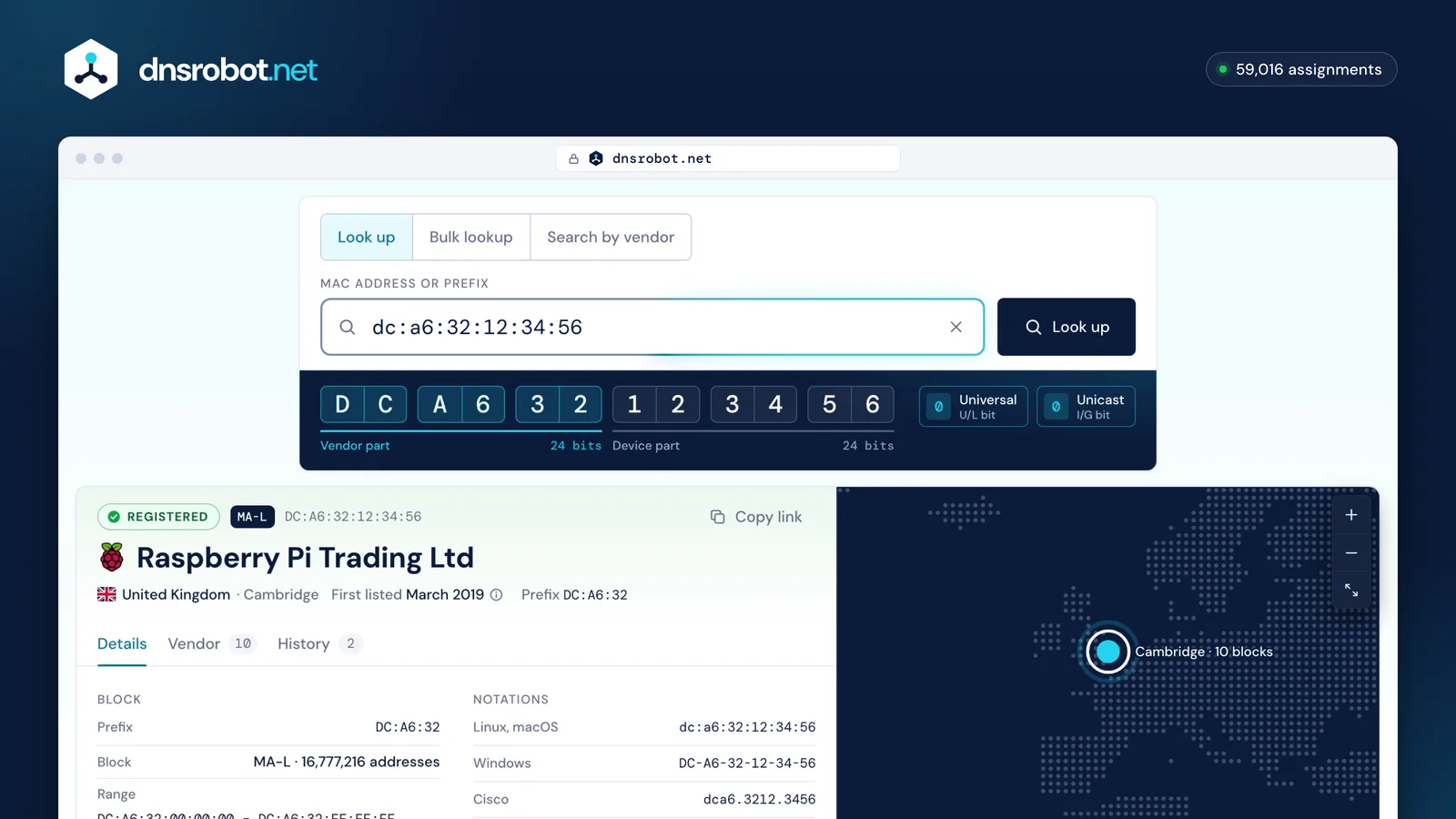
 The holderThe company the IEEE assigned this block to, and its country. A green mark means the registry names it.The blockThe assignment's type and size (MA-L, MA-M or MA-S) and the first and last address it covers.Vendor and device partsThe digits the vendor part covers: 6 for an MA-L block, 7 for MA-M, 9 for MA-S.The flag bitsThe first octet's two lowest bits: unicast or multicast, universal or local (randomized). Select one to flip it.
How do you read a MAC address?
A MAC address is 48 bits, written as 12 hex digits. The first half is the vendor part: the block the IEEE assigned to a company (the OUI). The second half identifies one network interface inside that block, and the company numbers those itself.
Two bits of the first octet change what the address means. The lowest, I/G, marks a group (multicast) address. The next, U/L, marks a locally administered address: one no maker assigned, which is why the second digit of a randomized address is always 2, 6, A or E.
MA-L24 bits
Raspberry Pi Trading Ltd
MA-M28 bits
Raspberry Pi (Trading) Ltd
MA-S36 bits
KST technology
Block sizes: MA-L, MA-M, MA-S
Large companies buy a 24-bit block; smaller ones buy a slice of a block the IEEE split. A lookup has to match the longest prefix first, or every MA-M and MA-S address reads "IEEE Registration Authority" (v1 of this tool did that).
| Assignment | Vendor part | Addresses | In the registry | IEEE fee |
|---|---|---|---|---|
| MA-L, MA-Large (the classic OUI) | 24 bits | 16,777,216 | 40,344 | $3,585 |
| MA-M, MA-Medium | 28 bits | 1,048,576 | 6,641 | $2,155 |
| MA-S, MA-Small | 36 bits | 4,096 | 7,235 | $910 |
| IAB (no longer issued) | 36 bits | 4,096 | 4,575 | — |
| CID, Company ID (local addresses) | 24 bits | 16,777,216 | 221 | $910 |
The fee is the IEEE's one-time price for a public listing (October 2026). Keeping the company's name out of the listing costs a yearly fee on top.
Why does a MAC address show no vendor?
Almost always because the address was never assigned by a maker. Check the second hex digit first:
It's randomized
A second digit of 2, 6, A or E means locally administered. iPhones, Android phones and Windows laptops show networks a random private Wi-Fi address instead of the hardware one, so there is no vendor to find.
The holder is private
238 assignments are listed as Private: the company paid the IEEE to leave its name out. The lookup can say the block is taken, not by whom.
It's a split block
Some 24-bit blocks hold thousands of small assignments. With only six digits the answer is the IEEE Registration Authority; enter all 12 to get the holder.
It isn't listed
A universal address no one holds was mistyped, made up, or set by hand. Check it against the device's label.
Private Wi-Fi addresses on each system
| System | Setting | Default since |
|---|---|---|
| iPhone, iPad, Apple Watch | Private Wi-Fi Address (Fixed, or Rotating every 2 weeks) | iOS 14 |
| Android | Use randomized MAC | Android 10 |
| Windows 10 and 11 | Random hardware addresses | Off by default |
| macOS | Private Wi-Fi address | macOS 15 Sequoia |
To find the real maker, look up the hardware address: on an iPhone it's Settings → General → About → Wi-Fi Address; on Android, Settings → About phone → Status (or turn randomization off for one network). MAC Address Generator makes random test addresses the same way phones do.
Which MAC addresses are special?
Some addresses mean more than their registry entry: protocol groups, virtual routers, and the default prefixes of virtual machines. The lookup above names them.
Sources: IANA Ethernet numbers, RFC 9542, IEEE 802.1Q, and each vendor's documentation.
| Address | What it is |
|---|---|
| FF:FF:FF:FF:FF:FF | BroadcastEvery device on the segment: ARP requests, DHCP discovery. |
| 01:00:5E:00:00:00 – 01:00:5E:7F:FF:FF | IPv4 multicastThe group's last 23 bits: 224.0.0.251 (mDNS) is 01:00:5E:00:00:FB. |
| 33:33:xx:xx:xx:xx | IPv6 multicastThe group's last 32 bits: ff02::1 (all nodes) is 33:33:00:00:00:01. |
| 01:80:C2:00:00:00 | Spanning TreeSTP, RSTP and MSTP BPDUs between switches. |
| 01:80:C2:00:00:02 | Slow ProtocolsLACP link aggregation and Ethernet OAM. |
| 01:80:C2:00:00:03 | 802.1XEAPOL frames for port and Wi-Fi authentication. |
| 01:80:C2:00:00:0E | LLDPNeighbours announcing their name and port. |
| 01:00:0C:CC:CC:CC | Cisco CDP, VTP, DTPCisco's discovery and trunking protocols. |
| 01:1B:19:00:00:00 | PTPIEEE 1588 clock synchronization. |
| 00:00:5E:00:01:xx | VRRPA virtual router's gateway address; xx is its router ID (RFC 9568). |
| 00:00:0C:07:AC:xx | HSRPCisco's virtual gateway; xx is the group number (RFC 2281). |
| 00:50:56, 00:0C:29 | VMwareVirtual machines' network adapters. |
| 08:00:27 | VirtualBoxVirtual machines' network adapters. |
| 00:15:5D | Hyper-VVirtual machines' dynamic addresses. |
| 52:54:00 | QEMU, KVMVirtual network cards (locally administered). |
| 02:42:xx:xx:xx:xx | DockerContainers on bridge networks up to Docker 27; the last four bytes are the container's IPv4 address. |
| 02:00:00:00:00:00 | Android placeholderWhat apps get instead of the real address since Android 6.0. |
| 00:00:5E:00:53:xx | DocumentationReserved for examples (RFC 9542), like 192.0.2.0/24. |
How do you find a device by its MAC address?
Find it in the list of devices your network has seen: your router's client list shows each device's name beside its MAC and IP address, and arp -a lists what your computer has talked to. Then look up all the MAC addresses at once with Bulk lookup above; the vendor usually gives each device away.
- 1
List your neighbours
Run
arp -a(Windows, macOS) orip neigh(Linux), or open your router's client list (DHCP leases). Router Login finds its admin page. - 2
Paste it all
Copy the whole output into Bulk lookup. Addresses in any notation are found, with the IP on the same line.
- 3
Read the vendors
Espressif is usually a smart plug or bulb, Raspberry Pi a hobby server, Amazon an Echo or Fire TV. A randomized address is a phone or laptop.
- 4
Still unsure?
Turn devices off one at a time and see which address disappears, or check the IP with IP Lookup if it's a public one.
arp -aLists the IPv4 neighbours this PC has talked to recently, with their MAC addresses (Windows writes them with dashes).
How do you find your MAC address?
On the device itself: no website can read your MAC address, because it never leaves your local network. Every network interface has its own (Wi-Fi and Ethernet differ), and these commands show the hardware address the lookup needs.
getmac /vLists each adapter with its physical address. ipconfig /all shows the same as Physical Address.
Who owns the most MAC addresses?
Counted from the IEEE registry: full 24-bit blocks (16.7 million addresses each) per organization, grouped by name. Then where the world's blocks are registered, how the registry has grown, and the prefixes behind the devices on a home network.
The ten largest holders
Full 24-bit blocks (MA-L), 16,777,216 addresses each; the share is of all 40,344 MA-L blocks. Select a company to see every prefix it holds.
| # | Organization | Country | MA-L blocks | Share |
|---|---|---|---|---|
| 1 | Apple United States | United States | 3.9% | |
| 2 | Huawei Technologies China | China | 3.5% | |
| 3 | Cisco SystemsUnited States | United States | 3.1% | |
| 4 | Samsung Electronics South Korea | South Korea | 2.3% | |
| 5 | Huawei DeviceChina | China | 1.7% | |
| 6 | Intel Malaysia | Malaysia | 1.7% | |
| 7 | ZTEChina | China | 1.3% | |
| 8 | Texas InstrumentsUnited States | United States | 1.0% | |
| 9 | Espressif British Virgin Islands | British Virgin Islands | 0.9% | |
| 10 | CommscopeUnited States | United States | 0.9% |



Where the blocks are registered
58,748 assignments in 108 countries, by registered address
- United States17,34829.5%
- China12,72221.7%
- South Korea3,5586.1%
 Germany3,1485.4%
 Taiwan3,0365.2%
 Japan2,7194.6%
 United Kingdom1,6482.8%
 France1,3092.2%
- 100 other countries13,26022.6%
How the registry has grown
The oldest archived copy of the IEEE listing, from June 1997, already names 1,435 of today's assignments. The registry now adds about 2,800 a year, and over the last ten years the smaller MA-M and MA-S blocks made up 39% of them.
- assignments
- 59,016
- organizations
- 32,798
- countries
- 108
Assignments by block type
Assignments in the listing at each year's end
- 4,485
- 59,016
Today's assignments, counted from the month each first appeared in an archived copy of the listing (Wayback Machine). Blocks withdrawn since are not counted.
Show the numbers
| Year | MA-L | MA-M | MA-S and IAB | CID | All |
|---|---|---|---|---|---|
| 2000 | 4,485 | — | — | — | 4,485 |
| 2001 | 5,485 | — | — | — | 5,485 |
| 2002 | 6,328 | — | 514 | — | 6,842 |
| 2003 | 7,083 | — | 694 | — | 7,777 |
| 2004 | 7,890 | — | 1,067 | — | 8,957 |
| 2005 | 8,869 | — | 1,364 | — | 10,233 |
| 2006 | 9,895 | — | 1,595 | — | 11,490 |
| 2007 | 11,046 | — | 2,129 | — | 13,175 |
| 2008 | 12,177 | — | 2,580 | — | 14,757 |
| 2009 | 12,347 | — | 2,660 | — | 15,007 |
| 2010 | 14,376 | — | 3,322 | — | 17,698 |
| 2011 | 15,808 | — | 3,920 | — | 19,728 |
| 2012 | 16,929 | — | 4,221 | — | 21,150 |
| 2013 | 18,796 | — | 4,604 | — | 23,400 |
| 2014 | 20,001 | 295 | 5,255 | — | 25,551 |
| 2015 | 21,475 | 552 | 5,572 | 21 | 27,620 |
| 2016 | 22,773 | 1,288 | 6,406 | 48 | 30,515 |
| 2017 | 24,271 | 1,761 | 6,928 | 65 | 33,025 |
| 2018 | 25,774 | 2,335 | 7,542 | 74 | 35,725 |
| 2019 | 27,294 | 2,890 | 8,190 | 91 | 38,465 |
| 2020 | 29,167 | 3,330 | 8,495 | 107 | 41,099 |
| 2021 | 31,234 | 3,924 | 9,155 | 107 | 44,420 |
| 2022 | 33,139 | 4,533 | 9,761 | 142 | 47,575 |
| 2023 | 34,818 | 4,947 | 10,187 | 162 | 50,114 |
| 2024 | 36,657 | 5,610 | 10,853 | 191 | 53,311 |
| 2025 | 38,545 | 5,858 | 11,329 | 202 | 55,934 |
| 2026 | 40,344 | 6,641 | 11,810 | 221 | 59,016 |
Prefixes of devices on a home network
The makers behind most of the addresses a router's client list shows. Each prefix opens in the lookup.
Raspberry Pi boards (B8:27:EB on the Pi 3 and older, DC:A6:32 on the Pi 4)
ESP32 and ESP8266 Wi-Fi chips in smart plugs, bulbs and other IoT gadgets
Echo speakers, Fire TV, Kindle, Ring and Blink cameras
Nest speakers and thermostats, Chromecast, Pixel
Routers, Deco mesh, Kasa and Tapo plugs and cameras
UniFi access points, switches and gateways
Mac, iPad and Apple TV hardware addresses
Galaxy phones, TVs and appliances



Newest assignments
Blocks that appeared in the IEEE listing between our syncs of Oct 14 – 18, 2026. We check it every month.
- 14:AB:7ECienaMA-L
- 1C:CC:CDTecno Mobile
 MA-L
- 20:51:A5NetAppMA-L
- 24:91:23SZ DJI Ronin TechnologyMA-L
- 40:53:B3Sunitec TechnologyMA-L
- 48:13:18ZTEMA-L
- 5C:AB:22:3Xiamen Joint TechMA-M
- 5C:AB:22:6Shanghai Jiweijiu Intelligent TechnologyMA-M




Is there a MAC address lookup API?
Yes, free and without a key: the same data as this page, as JSON. It takes an address or a prefix in any notation and answers with the holder, the block, the flags and the IPv6 interface ID.
Limits: 120 requests a minute per IP. CORS is open, so it works from a browser. Client libraries for Go, PHP, Rust, .NET and more are on GitHub.
$ curl "https://dnsrobot.net/api/mac-lookup?mac=DC:A6:32:12:34:56"
{
  "vendor": "Raspberry Pi Trading Ltd",
  "oui": "DCA632",
  "countryCode": "GB",
  "registry": "MA-L",
  "blockSize": 16777216,
  "isLocal": false,
  "isMulticast": false,
  "kind": "vendor",
  "ipv6": { "linkLocal": "fe80::dea6:32ff:fe12:3456", … },
  …
}$ curl -X POST https://dnsrobot.net/api/mac-lookup \
-H "Content-Type: application/json" \
-d '{"macs": ["DC:A6:32:12:34:56", "00:15:5D:3A:1B:2C"]}'
$ curl "https://dnsrobot.net/api/mac-lookup?vendor=raspberry%20pi"MAC address lookup questions
How do I look up a MAC address?
Can I identify a device by its MAC address?
arp -a shows the hostname beside the address. It never tells you the owner or the location, and a randomized address names no maker at all.Can a MAC address be traced to a location or a person?
Is there a WHOIS for MAC addresses?
What are the first six digits of a MAC address?
Why does my MAC address show as randomized or with no vendor?
Why do other tools say "IEEE Registration Authority"?
Can a MAC address be changed?
ip link set dev eth0 address … on Linux. That is why a MAC address proves nothing about a device's identity.Is a MAC address the same as an IP address?
How can I look up many MAC addresses at once?
arp -a, ip neigh, a DHCP lease list or a switch's MAC table. It finds every address in any notation, keeps the IP from the same line, and exports the results as CSV.How do I find every MAC prefix a company owns?
How up to date is the vendor database, and can I download it?
Missing something?Suggest a feature or a new tool
Related network tools
MAC Address Generator
Generate random MAC addresses with vendor prefix options
IP Lookup
Look up IP address geolocation, ISP, and network details instantly
What Is My ISP
Discover your ISP, ASN, and connection details
Router Login
Open your router's admin page, fix typos like 192.168.l.l and find default logins by brand
Port Checker
Test port connectivity and service availability
Subnet Calculator
Network, broadcast, usable hosts and masks for any IPv4 or IPv6 block, plus VLSM, splits and cloud subnets