









IPv6 Subnet Calculator
Type an IPv6 prefix to see its range, how many /64s it holds and its reverse zone, then split it or plan sites and VLANs on 4-bit nibble boundaries.
Type an IPv6 prefix, an address with its prefix length, or a range with a dash. Drag the line between the bits to change the prefix. Nothing leaves your browser.
65,536 /64 subnets · 1,208,925,819,614,629,174,706,176 addresses
- There is no broadcast in IPv6. The address with an all-zero interface ID is the Subnet-Router anycast address (RFC 4291), and the top 128 interface IDs of each subnet are kept for anycast (RFC 2526).
- 1
The prefix
/48 keeps the first 48 bits: 12 hex digits
address2001:0db8:abcd:0000:0000:0000:0000:0000 - 2
Network = the prefix, then zeros
network2001:0db8:abcd:0000:0000:0000:0000:00002001:db8:abcd:: - 3
Last address = the prefix, then ones
IPv6 has no broadcast address
last2001:0db8:abcd:ffff:ffff:ffff:ffff:ffff2001:db8:abcd:ffff:ffff:ffff:ffff:ffff - 4
Addresses = 2128 − 48 = 280
Exactly 1,208,925,819,614,629,174,706,176
- 5
/64 subnets = 264 − 48 = 65,536
How does IPv6 subnetting work?
An IPv6 address is 128 bits: a routing prefix from your provider, a subnet ID you choose for each network, and a 64-bit interface ID each device fills in. Subnetting IPv6 means choosing the subnet ID's bits.
RFC 4291 sets the layout: a global routing prefix, a subnet ID and an interface ID, and every global address has a 64-bit interface ID. So the routing prefix and the subnet ID share the first 64 bits, and one network is a /64. The classic layout, from RFC 3587, is a /48 routing prefix and a 16-bit subnet ID: 65,536 networks per site.
You don't size IPv6 subnets by host count as in IPv4: every LAN is a /64 whatever its size, because stateless address autoconfiguration (SLAAC) needs a 64-bit interface ID (RFC 7421). What you plan is how many subnets you need and how to group them.
Type any prefix in the IPv6 calculator above to see its bits on the ruler, then Split or Plan it. Range → CIDR makes it an IPv6 range calculator: type two addresses with a dash for the fewest prefixes that cover them.
2001:0db8:abcd:0012:0000:0000:0000:0001
- Global routing prefix48 bits · /0 → /482001:0db8:abcd
- Subnet ID16 bits · /48 → /640012
- Interface ID64 bits · /64 → /1280000:0000:0000:0001
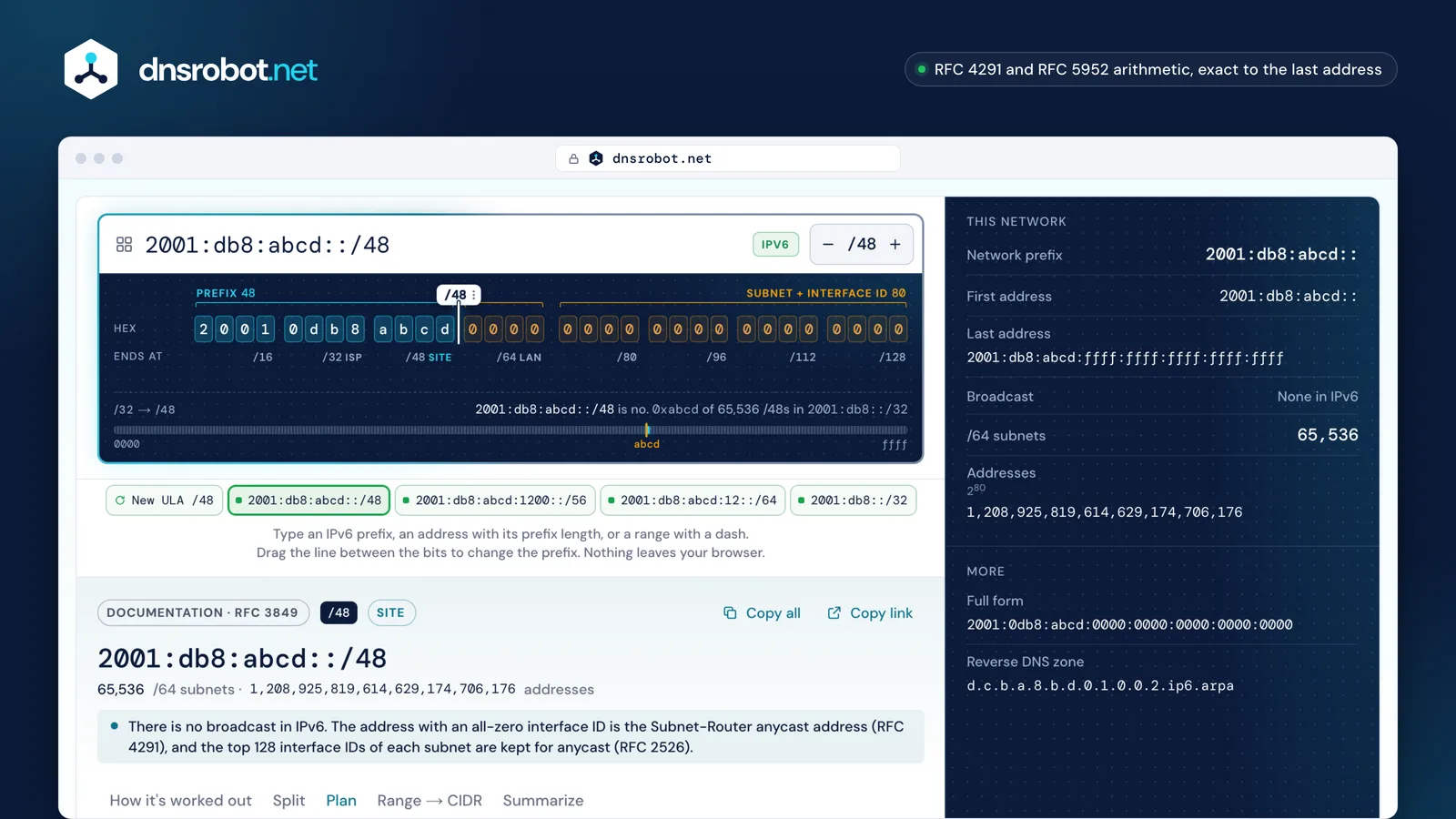
 The prefix, bit by bitThe ruler marks the usual boundaries: /32 for an ISP, /48 for a site, /64 for a LAN.A new ULA /48A random unique local prefix, made in your browser and never sent.Exact counts65,536 /64 subnets and every address in the block, counted exactly.Its reverse zoneThe ip6.arpa zone where the block's reverse DNS lives, beside its full 32-digit form.
How many /64 subnets are in a /48, /56 or /60?
A /48 holds 65,536 /64 subnets, a /56 holds 256 and a /60 holds 16. A prefix n bits shorter than /64 holds 2ⁿ of them: every 4 bits is one more hex digit and 16 times as many.
The table counts exactly, to the last address. The sizes people meet: a /32 is the smallest block ARIN, the RIPE NCC and APNIC allocate to an ISP, a /48 is a site, a /56 is the smallest prefix RIPE-690 advises ISPs to give a home, and a /64 is one LAN.
As an IPv6 prefix calculator, the tool above counts any length the same way, /0 to /128. Inside a /64 the count is addresses, not subnets: 18,446,744,073,709,551,616 of them. Nobody fills a /64; the space lets devices pick their own addresses without asking, which RFC 7934 recommends networks allow.
| Prefix | Typical use | /48s | /56s | /64 subnets | Addresses |
|---|---|---|---|---|---|
| /32 | an ISP's smallest allocation | 65,536 | 16,777,216 | 4,294,967,296 | 29679,228,162,514,264,337,593,543,950,336 |
| /36 | 4,096 | 1,048,576 | 268,435,456 | 2924,951,760,157,141,521,099,596,496,896 | |
| /40 | 256 | 65,536 | 16,777,216 | 288309,485,009,821,345,068,724,781,056 | |
| /44 | 16 | 4,096 | 1,048,576 | 28419,342,813,113,834,066,795,298,816 | |
| /48 | a site | 1 | 256 | 65,536 | 2801,208,925,819,614,629,174,706,176 |
| /52 | – | 16 | 4,096 | 27675,557,863,725,914,323,419,136 | |
| /56 | a home (RIPE-690's smallest) | – | 1 | 256 | 2724,722,366,482,869,645,213,696 |
| /60 | – | – | 16 | 268295,147,905,179,352,825,856 | |
| /64 | one LAN | – | – | 1 | 26418,446,744,073,709,551,616 |
What IPv6 prefix will my ISP give me?
Your router receives a prefix from the ISP by DHCPv6 prefix delegation and gives each of its networks a /64 from it. RIPE-690 advises ISPs to give every customer a /48, or businesses a /48 and homes a /56, always on a whole hex digit: /48, /52, /56 or /60.
The chain runs from the registries down. A regional registry allocates an ISP at least a /32 (ARIN, RIPE NCC, APNIC). The ISP delegates a prefix to your router with DHCPv6 prefix delegation (RFC 9915, which replaced RFC 8415 in January 2026), and the router gives each of its LAN interfaces its own /64 from that prefix (RFC 7084, requirement L-2).
A router may hint at the size it wants, rounded up to a whole hex digit, but it must accept what it gets (RFC 7084). Since RFC 9818 (July 2025), a home router must keep the part of the prefix it doesn't use available to other routers behind it.
Few ISPs publish the size on their own pages, so look for the delegated prefix on your router's IPv6 status page and type it in above. RIPE-690 strongly discourages delegating anything longer than a /56, and a single /64 leaves you nothing to split. The IPv6 Test shows whether your connection uses IPv6 at all.
How do I plan IPv6 subnets on nibble boundaries?
Give each level of your network whole hex digits: one digit for up to 16 sites, two for up to 256 VLANs. Every block then starts and ends on a digit, reads cleanly, and maps to exactly one ip6.arpa zone for reverse DNS.
Reverse DNS names an IPv6 address digit by digit, in reverse, under ip6.arpa (RFC 3596), so a reverse zone can only be cut at a hex digit. RIPE-690 asks ISPs to delegate prefixes on 4-bit (nibble) boundaries to align with those zones, and ARIN makes its allocations on nibble boundaries.
Plan from the top: name each level, count what you need now, round each level up to whole digits and keep a digit spare above the first level. The figure is the Plan tab's answer for a /48 with 3 sites and 20 VLANs each: the sites take one digit, the VLANs two, and one digit stays in reserve.
A prefix off a nibble boundary still routes (RFC 7608 requires forwarding on any length), but its reverse DNS spans several zones: a /57 needs 8, a /58 needs 4.
2001:0db8:abcd:0213:0000:0000:0000:0000
- Your /48
- Reserve
- Sites 3
- VLANs 20
- Interface ID
Reverse zone of site 3, VLAN 203.1.2.0.d.c.b.a.8.b.d.0.1.0.0.2.ip6.arpa
Which IPv6 prefix lengths should I use?
A /64 for every LAN, a /127 between two routers, a /128 for a loopback, and a /48 or /56 for a whole site. A LAN with a prefix longer than /64 loses SLAAC.
SLAAC needs a /64 (RFC 4291, RFC 7421). On a link between two routers, RFC 6164 made /127 standard, the IPv6 version of an IPv4 /31, and routers must support it. Prefixes longer than /64 are valid: RFC 7608 requires routers to forward on any length. They only lose SLAAC, so they suit router links and servers numbered by hand, not networks of phones and laptops.
| Use | Length | Why |
|---|---|---|
| A LAN (phones, laptops, servers) | /64 | SLAAC needs a 64-bit interface ID (RFC 4291, RFC 7421) |
| A link between two routers | /127 | The IPv6 /31; routers must support it (RFC 6164) |
| A loopback or one host | /128 | A single address |
| A home | /56 | 256 LANs; RIPE-690's smallest for a customer |
| A site or business | /48 | 65,536 LANs; RIPE-690's advice for every customer |
| An ISP | /32 | The registries' smallest allocation (ARIN, RIPE NCC, APNIC) |
What is a ULA, and how do I generate one?
A unique local address (ULA) prefix is fd followed by a random 40-bit Global ID: a /48 for use inside your site that isn't routed on the Internet. The New ULA /48 chip above is a ULA generator: the random bits come from your browser and are never sent.
RFC 4193 reserves fc00::/7. The next bit, L, is 1 for a prefix you assign yourself, so in practice every ULA starts with fd. The 40-bit Global ID must be pseudo-random, never sequential or a well-known number, so that two networks joined later almost never clash.
RFC 4193 suggests making the Global ID from SHA-1 over the time and a hardware identifier, but any good random source meets the requirement; this page uses your browser's cryptographic random generator. The odds of a clash stay small: the figure applies the RFC's own formula.
A ULA is not a firewall or NAT: it is simply not routed on the Internet. Use one beside your global prefix for internal services that should keep their addresses when the ISP's prefix changes.
- fdfc00::/7 + L = 18 bits
- 5b:3c91:0e72Global ID, random40 bits
- 0000–ffffSubnet ID16 bits
- …Interface ID64 bits
| Networks joined | Chance of a clash |
|---|---|
| 10 | ≈ 1 in 22,000,000,000 |
| 100 | ≈ 1 in 220,000,000 |
| 1,000 | ≈ 1 in 2,200,000 |
| 10,000 | ≈ 1 in 22,000 |
IPv4 vs IPv6 subnetting: what changes?
In IPv4 you size each subnet by its host count and lose two addresses to the network and broadcast; in IPv6 every LAN is a /64, there is no broadcast, and you plan how many subnets rather than how many hosts.
What carries over: CIDR notation, splitting a block into equal halves, and summarizing neighbours into one prefix. The Subnet Calculator does both families; this page starts on IPv6 and adds the Plan tab.
| IPv4 | IPv6 | |
|---|---|---|
| Address size | 32 bits | 128 bits |
| Written as | 192.168.1.0/24 or a mask, 255.255.255.0 | 2001:db8:abcd:12::/64, prefix length only |
| Broadcast | The last address of each subnet | None: multicast (ff02::1) does that job |
| Usable addresses | 2ⁿ − 2 | All but the Subnet-Router anycast (interface ID 0) and the top 128 interface IDs (RFC 2526) |
| Subnet size | Sized to its hosts (VLSM) | Always /64 for a LAN |
| Private ranges | 10/8, 172.16/12, 192.168/16 (RFC 1918) | fd00::/8 unique local, a random /48 per site (RFC 4193) |
| Reverse DNS | in-addr.arpa, one label per octet | ip6.arpa, one label per hex digit |
IPv6 subnetting questions
How many /64 subnets are in a /48?
How many addresses are in a /64?
Why is every IPv6 LAN a /64?
Does IPv6 have a broadcast address?
What is the difference between a /48 and a /56?
Can I use a /127 between routers?
What is a nibble boundary?
Is fd00::/8 like 10.0.0.0/8?
Missing something?Suggest a feature or a new tool
Related tools
Subnet Calculator
Network, broadcast, usable hosts and masks for any IPv4 or IPv6 block, plus VLSM, splits and cloud subnets
IPv6 Test
Test if your IPv6 works, which family your browser picks and if a site has IPv6
IPv6 Compression
Shorten or expand IPv6 addresses the RFC 5952 way and see which rule removed each zero
IPv6 to IPv4
Find the IPv4 address inside an IPv6 one: mapped, NAT64, 6to4, Teredo and ISATAP, bit by bit
Reverse DNS Lookup
Find hostnames associated with any IP address via PTR records
IPv6 Ping
Ping an IPv6 address or hostname from 11 places by TCP connect, with IPv4 beside it for dual-stack names